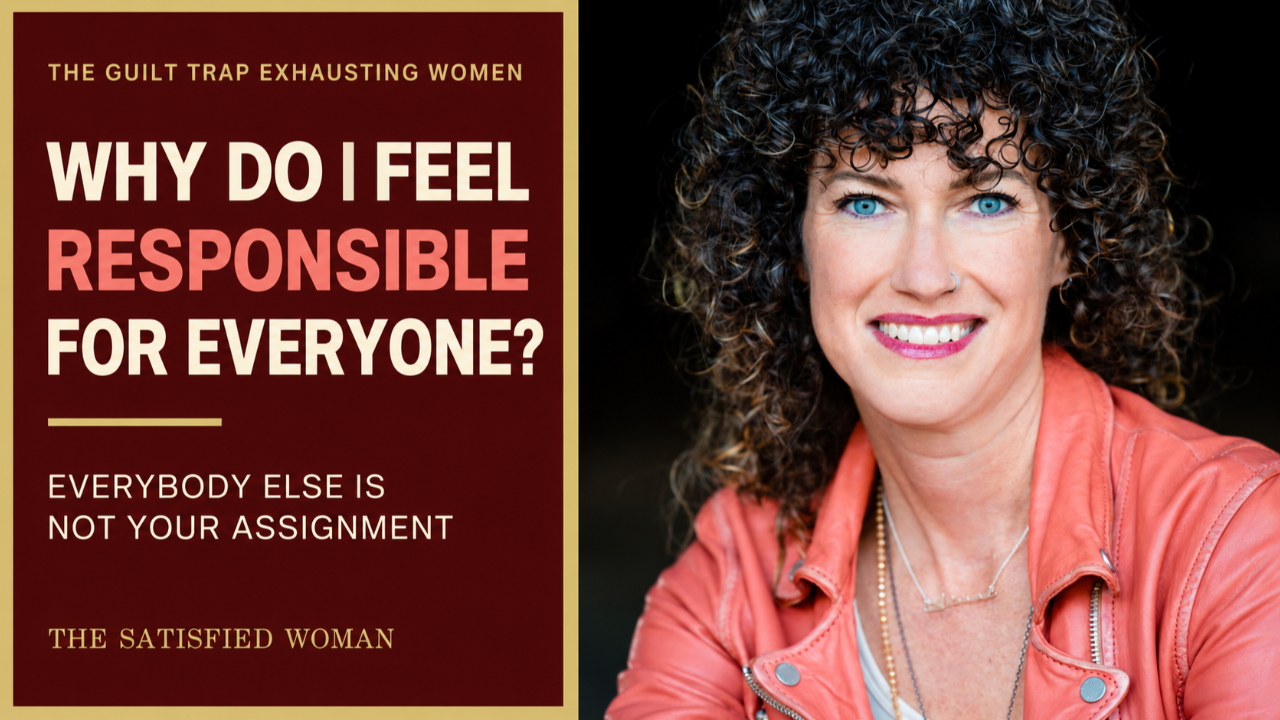
Why Do I Feel Responsible for Everyone? The Guilt Trap Exhausting Women
If someone you love is upset, disappointed, confused, or struggling, do you immediately assume it’s your job to fix it?
You listen longer than you want to. You solve problems nobody asked you to solve. You rearrange your day, absorb somebody else’s stress, and keep going until everyone around you seems okay.
Then you finally turn toward your own life—exhausted, resentful, and wondering why nobody takes care of you.
You feel responsible for everyone because you learned that being a good woman means being useful to everybody else.
That responsibility isn’t necessarily an act of love. It’s evidence that your goodness became fuel for other people’s comfort.
Your life doesn’t have to depend on everyone else being okay.
The free Feminine Reset helps you put your needs back into the picture and make choices that support the woman living your life—you.
Why Do I Feel Responsible for Everyone?
Women receive this training early.
Notice what everyone needs. Keep the family connected. Remember the appointments. Prevent the conflict. Make the gathering pleasant. Help the struggling friend. Protect the partner from discomfort. Be grateful. Be agreeable. Don’t ask for too much.
A girl who reads the room and responds to other people’s needs gets praised as mature, thoughtful, easy, and kind. A woman who continues doing it becomes the person everybody depends on.
Her competence gets rewarded with more responsibility—not more care.
Eventually, she stops asking whether a problem belongs to her. She sees distress and gets to work.
The result looks admirable from the outside. She’s reliable at work, indispensable at home, generous with friends, and attentive in love. Inside, she’s angry that everyone expects so much from her.
They expect it because she has taught them to.
Caring About Someone Isn’t the Same as Becoming Responsible for Them
Caring belongs in healthy relationships. Responsibility has limits.
You’re responsible for your choices, your words, your agreements, your children’s well-being, and the commitments you consciously make.
You aren’t responsible for making another adult feel happy about your decisions. You aren’t responsible for preventing every disappointment, rescuing people from consequences, or turning their lives into something that works.
That distinction changes everything.
Your partner has a difficult day. Caring means listening and deciding what support you genuinely want to offer. Taking responsibility means abandoning your evening, managing his mood, and refusing to relax until he feels better.
Your friend hates her job. Caring means hearing her and asking what she wants to do. Taking responsibility means researching opportunities, rewriting her résumé, checking whether she applied, and feeling frustrated when she doesn’t.
Your mother dislikes a decision you made. Caring means recognizing her feelings. Taking responsibility means changing the decision so she doesn’t have to experience them.
Love does not require you to run another adult’s emotional life.
Why Guilt Shows Up the Moment You Stop
Guilt has kept this arrangement running for years.
The second you say no, disappoint someone, leave a problem unsolved, or choose what works for you, guilt arrives with an accusation: You’re selfish. You’re letting them down. A good woman wouldn’t do this.
Guilt doesn’t prove you did something wrong. It proves you violated an expectation.
The expectation comes from your family, your relationship, your workplace, your religion, or the larger culture that benefits when women remain endlessly available.
A woman who feels responsible for everyone becomes remarkably easy to exploit. She completes the unpaid labor. She absorbs the conflict. She accepts less support. She stays after the relationship stops serving her because leaving would upset too many people.
Read Women Do the Work That Holds the World Together for a deeper look at the labor women perform without recognition or compensation.
Your Usefulness Has Replaced Your Needs
When your value depends on being useful, your needs begin to look like interruptions.
You’ll eat after everyone else. Rest when everything is finished. Spend money on yourself after everybody has what they need. Speak honestly once you find a version of the truth nobody objects to.
Of course, everything is never finished. Somebody always needs something. The day when your life finally moves to the front never arrives.
This is how a capable woman builds a life that doesn’t satisfy her.
She isn’t missing gratitude. She isn’t failing to manage her time. She has organized her life around a hierarchy in which everybody else counts first.
Your needs belong inside every decision that affects your life.
That doesn’t make you cruel. It makes you a participant in your own existence.
Listen Next
Why Do Women Feel Responsible for Everyone’s Feelings?
Episode 44 of The Satisfied Woman goes further into the guilt trap and the emotional responsibility women assume in families, friendships, and love.
What Happens When You Stop Taking Responsibility for Everyone?
Some people won’t like it.
The person who benefited from your endless availability calls your boundary selfish. The coworker who relied on you to finish everything questions your commitment. The family member who used guilt to secure your cooperation increases the guilt.
Their reaction isn’t an instruction.
It’s information about how much the relationship depended on your compliance.
Healthy adults adjust. They solve their problems, communicate their needs, tolerate disappointment, and participate in the relationship. People committed to your usefulness demand that you return to your old role.
You don’t need everybody to approve of the change. You need to recognize whose life you’re responsible for.
How to Stop Feeling Responsible for Everyone
Ask: Whose feeling, choice, or problem is this?
Name the actual owner before you act. (because, it's probably not you)
If your partner is angry about a boundary, the boundary belongs to you and the anger belongs to him. If your friend keeps choosing the same unavailable man, her decision belongs to her. If your adult child forgot a deadline, the consequence belongs to your adult child.
You don’t have to become indifferent. You have to stop confusing their feelings with something you're responsible for.
Decide what you genuinely want to contribute
Support works best as a choice.
Ask yourself: What am I willing to give here? Choose to listen for twenty minutes, share one resource, or help once and let the other person handle what follows.
A clear yes feels different from resentful compliance.
Let adults experience their own responses
Someone’s disappointment does not require you to backpedal.
Let the other person disagree. Let them feel frustrated. Let them solve the problem in a way you wouldn’t choose. Their capacity grows when you stop intercepting every difficult experience.
Put your needs into the decision before you answer
Before you say yes, ask what the request costs you.
Does it cost sleep, money, time, focus, pleasure, safety, or the promise you already made to yourself?
Your need doesn’t automatically outrank theirs. It does count.
You Are Allowed to Be More Than Useful
You deserve relationships built around who you are—not merely what you provide.
You deserve to receive support before you collapse. You deserve time that doesn’t get reassigned to somebody else’s emergency. You deserve choices that reflect your desires, even when another person prefers something different.
This is the work of sovereignty.
Sovereignty doesn’t mean isolation. It means your life belongs to you. You remain loving, connected, generous, and relational without disappearing into everybody else.
If you’ve built your identity around being the strong one, read The Power of Sovereignty for Women. If saying no immediately makes you feel guilty, continue with Permission to Stop Performing.
Everybody Else Is Not Your Assignment.
The free Feminine Reset helps you stop organizing your life around everybody else’s needs and start making choices that include your own.
Keep Reading