EXPLORE THE CERTIFICATION

What Is Feminine Psychology? A New Framework for Women's Satisfaction
feminine energy feminine psychology podcast the four keys the satisfied method women's psychology
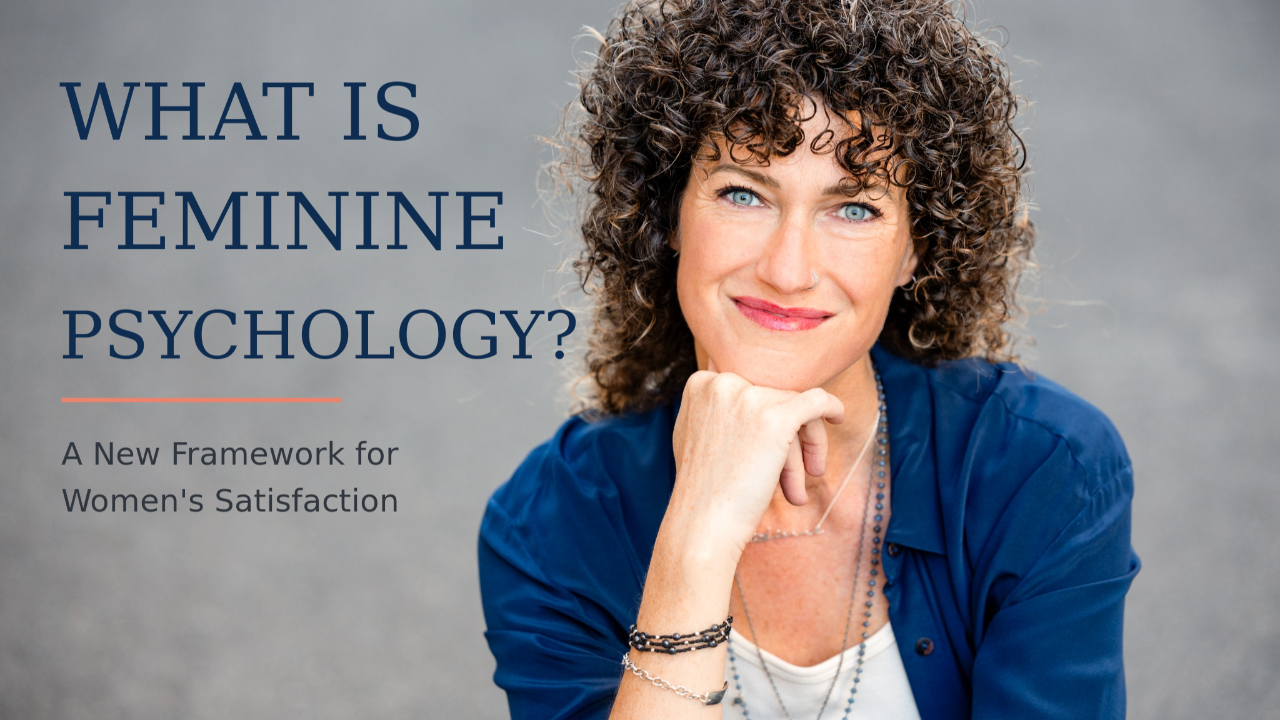
Alanna Kaivalya, Ph.D., founder of the Satisfied Method™ and contemporary feminine psychology framework.

For most of its history, psychology has asked women to locate themselves inside theories that were not built around them.

Even when the field began examining women more seriously, the central question remained reactive: How had male psychologists misunderstood women? Where had supposedly universal theories treated men's experiences as the human norm? What had Freud, Jung, and their successors gotten wrong?

Those questions mattered. They still matter.

But they are not the same question I am asking.

I am not interested only in correcting psychology's picture of women. I am interested in beginning with women.

Who are women on our own terms?

What do we need?

How do our bodies, emotions, intuition, relationships, desires, developmental experiences, and cultural realities shape our psychological lives?

What allows a woman not merely to function, achieve, cope, or survive—but to become deeply satisfied?

That is the territory of contemporary feminine psychology.

Feminine psychology is the study and practical application of women's psychological lives on women's own terms. It recognizes that femininity has its own qualities, intelligences, developmental experiences, needs, standards, and conditions for satisfaction—not merely qualities assigned to women in contrast or response to men.

I have spent more than twenty years studying psychology, mythology, spirituality, femininity, relationships, and transformation. I hold a Ph.D. in Mythological Studies with an emphasis in Depth Psychology, have written five books, and developed international professional training programs. My book, The Way of the Satisfied Woman, presents the foundation of this work.

One sentence from that book states the entire proposition:

Femininity has its own qualities, its own standards, and its own realm of satisfaction.

Women deserve a psychology that starts there.

Why Women Need Psychology on Our Own Terms

The foundations of modern Western psychology were substantially shaped by male theorists working inside male-dominated institutions. Their theories were presented as accounts of human development, motivation, sexuality, health, and maturity—even when the lives used to formulate those theories were largely male.

Feminist psychologists exposed this problem. Beginning with early critics such as Karen Horney and expanding through the feminist psychology movements of the twentieth century, scholars challenged male bias in psychological theory, research, diagnosis, and clinical practice. Later feminist scholarship also challenged the field's methods and assumptions about who produces knowledge and whose experience counts as evidence.

That work created essential corrections. It documented bias. It made women visible. It questioned the idea that men's experiences represented a universal human template.

Contemporary feminine psychology must take the next step.

It cannot remain organized around rebutting male theories. A psychology built entirely in reaction to male psychology still permits male psychology to set the original terms.

Women are not a correction to men.

We are not failed men, incomplete men, more emotional men, or men with different reproductive organs. Nor are we one interchangeable group with identical temperaments, histories, desires, or lives.

We are women. Our psychology deserves primary study—not merely comparative study.

Other areas of psychology recognize that meaningful differences in development and lived conditions require specialized understanding. Child psychology does not treat a child as a defective adult. Developmental psychology examines how human capacities and needs change across the lifespan. Cultural psychology recognizes that psychological life cannot be separated from social context.

In the same way, women's embodied, developmental, relational, and cultural experience deserves a framework capable of understanding it directly.

Feminine Psychology Is Not the Same as Feminist Psychology

The two fields overlap, but they do different work.

Feminist psychology examines how gender, power, inequality, social roles, and patriarchal structures influence psychological theory and women's lives. It has been crucial in identifying bias, challenging stereotypes, and expanding whose experience is represented in psychological research and practice.

Contemporary feminine psychology asks a more foundational and applied set of questions:

  • What is the nature of the feminine psyche?
  • What forms of intelligence have women been trained to dismiss?
  • What conditions allow women to express themselves fully?
  • How do embodiment, development, relationship, sexuality, creativity, and culture interact in a woman's psychological life?
  • What creates satisfaction for women?
  • How can practitioners guide women through transformation without forcing them into male-centered standards of achievement, independence, or emotional control?

Feminist psychology shows us where women have been excluded or misrepresented.

Feminine psychology helps define women on our own terms and builds a practical path forward.

Feminine Psychology Is More Than Feminine Energy

The phrase feminine energy has become popular online. At its best, it gives women language for intuition, emotion, receptivity, creativity, connection, sensuality, and relational intelligence. It can help a woman recognize why relentless productivity, control, and self-sufficiency have left her exhausted.

At its worst, feminine-energy teaching becomes an aesthetic or a dating performance. Wear the dress. Speak in a certain tone. Become less direct. Make a man pursue you. Look receptive while calculating the outcome.

That is not feminine psychology.

Femininity is not a costume, a manipulation tactic, or a set of behaviors designed to secure male attention.

Feminine psychology examines the full interior and relational architecture beneath the behavior:

  • whether a woman feels safe enough to be fully herself
  • whether she has reliable access to what she needs
  • whether she trusts herself, her circumstances, and the people around her
  • whether her emotions and intuition are respected
  • whether she can identify and express her needs and desires
  • whether her relationships support her psychological well-being
  • whether her work, money, home, and decisions reflect her values
  • whether her life creates genuine satisfaction

Feminine energy is one part of the territory. Feminine embodiment is one part of the territory. Feminine psychology is the larger framework capable of explaining how those dimensions interact with the rest of a woman's life.

Approach Central concern What it contributes
Feminine psychology Women's psychological lives on women's own terms A complete framework for satisfaction, development, embodiment, relationship, power, and transformation
Feminist psychology Gender bias, inequality, representation, and power Essential critique of male-centered theory and institutions
Feminine energy Intuition, emotion, receptivity, creativity, sensuality, and relational intelligence Accessible language for feminine qualities and experience
Feminine embodiment The body as a site of awareness, meaning, and transformation Practices reconnecting psychological insight with lived bodily experience

The Feminine and Masculine as Psychological Polarities

Within the framework I teach, the feminine and masculine are psychological polarities. They are not simplistic synonyms for woman and man, and they are not rigid instructions for gender performance.

Listen: Episode 3: A Brief Definition of the Feminine Polarity and the Feminine Psyche

Every psyche contains access to both.

The masculine is associated with logic, direction, structure, protection, provision, conscious decision-making, and linear movement toward an aim.

The feminine is associated with intuition, emotion, receptivity, relationship, creativity, desire, unconscious intelligence, and cyclical transformation.

Both are valuable. Both are necessary.

Listen: Episode 10: Psychological Dynamics—Understanding Masculine and Feminine Energies Within Our Psyche

Problems arise when a woman is required to live almost entirely through masculine standards and functions while distrusting or suppressing her feminine intelligence.

She can become tremendously competent. She can build the company, manage the family, solve every problem, anticipate every need, and maintain control of every moving piece.

She can also become exhausted, disconnected from desire, unsupported in relationship, unable to receive, and unsure why the life she worked so hard to create does not satisfy her.

Feminine psychology does not ask her to abandon logic, agency, ambition, or competence. It asks her to stop treating those qualities as the only credible forms of power.

Female Embodiment Shapes Psychological Life

Women do not experience psychology as minds floating separately from bodies.

From childhood onward, a girl develops inside a body that changes visibly, becomes socially interpreted, encounters sexual possibility and threat, and eventually contends with menstruation, fertility, reproductive choice, pregnancy or non-motherhood, hormonal shifts, aging, and menopause according to her individual life.

Not every woman experiences every event. No single biological fact determines her personality, destiny, or worth.

But female embodiment creates developmental and cultural realities that cannot be dismissed as psychologically irrelevant.

A menstruating body teaches change. It introduces cycles of energy, sensation, emotion, blood, possibility, and renewal. The reproductive capacity of the female body—whether used, unused, wanted, unwanted, available, or lost—exists within a vast social and symbolic field. Women encounter expectations about desirability, motherhood, caregiving, sexuality, age, safety, and value that shape the psyche from an early age.

My doctoral grounding in depth psychology and mythology also informs this understanding. Psychological life is not produced only through conscious thought. It is formed through symbol, story, image, dream, body, family, culture, and the unconscious.

Feminine psychology must account for all of it.

Intuition and Emotion Are Forms of Feminine Intelligence

Our culture tends to place logic and reason at the top of an imagined hierarchy of intelligence. Emotion is treated as interference. Intuition is treated as unreliable unless it can immediately defend itself with evidence.

Women learn this lesson early.

Do not be so emotional.

You are overreacting.

That did not happen the way you think it did.

You are being irrational.

You are acting crazy.

The result is not simply hurt feelings. It is psychological destabilization. A woman learns to interrogate her own perception before she evaluates the person or circumstance that caused her concern.

Within feminine psychology, intuition is a woman's primary form of knowing. Emotion is one of the central ways that knowing registers in her psyche and body.

An emotion tells us that something inside us has responded.

An intuitive response alerts us to meaning, congruence, danger, possibility, desire, or conflict before the conscious mind has assembled a complete explanation.

Intuition is not an infallible command, but neither is it a subordinate hypothesis waiting for logic to authorize it. It is the first knowing. A woman can then check that knowing against context, evidence, experience, and reason. Logic helps her verify, interpret, and act upon what her intuition has revealed; it is not the source from which her deepest knowing originates.

We do not have to choose between intuition and logic. They perform different functions. The problem arises when logic is permitted to cross-examine intuition while intuition is never permitted to challenge logic.

A woman's emotions and intuition do not merely belong somewhere inside her decision-making process. They lead it. Denying them does not make her more rational. It disconnects her from her primary way of knowing.

Satisfaction Is the Feminine Measure of a Life

Modern women have been taught to pursue success according to measures established long before most women had meaningful influence over the institutions defining those measures.

Earn more. Produce more. Advance further. Need less. Handle everything. Do it yourself.

Success can be meaningful. Achievement can create freedom, money, contribution, and pride. But success and satisfaction are not the same.

As I define it throughout my work:

Satisfaction is the pleasure derived from the fulfillment of one's wishes or needs.

That definition changes the measure.

Success asks: What did you accomplish?

Satisfaction asks: What did the accomplishment create inside your life?

Did it fulfill a need? Did it bring pleasure? Did it support your relationships? Did it make room for creativity? Did it increase your freedom? Did it create the life you actually wanted to inhabit?

A woman can be successful and deeply dissatisfied. She can possess the career, income, marriage, home, or reputation she was told to pursue and still recognize that her wishes and needs have disappeared from the structure of her life.

Feminine psychology restores them to the center.

Listen: Episode 2: What Does It Mean to Be a Satisfied Woman?

The Four Keys of Feminine Satisfaction

Foundational Teaching

The Four Keys to Feminine Satisfaction

Hear Alanna teach the original framework in full. Watch Episode 17 on YouTube.

The Satisfied Method™ identifies four foundational conditions that support a woman's capacity for satisfaction:

THE FIRST KEY

Safety

I can be fully myself without threat of harm.

Masculine support: Protection

THE SECOND KEY

Security

What I need will be reliably available.

Masculine support: Provision

THE THIRD KEY

Trust

My perception is honored and behavior demonstrates congruence.

Masculine support: Integrity

THE FOURTH KEY

Being Cherished

My emotions and intuition matter, and I am not abandoned inside my pain.

Masculine support: Presence

1. Safety

Safety is the ability to be fully herself without threat of harm in body, mind, heart, identity, or spirit.

It includes physical safety, but it does not end there. A woman needs relationships, homes, workplaces, and communities in which she can tell the truth, express herself, set boundaries, and exist without continual vigilance.

2. Security

Security is the reliable knowledge that what she needs will be available.

It includes material provision, consistency, shelter, money, food, care, commitment, and the dependable structures that allow the nervous system to leave survival mode. A woman cannot devote herself fully to creativity, desire, or expansion while scrambling continuously to secure the basics.

3. Trust

Trust exists within the woman and between the woman and her world.

She needs confidence in her own perception, intuition, decisions, and capacity to respond. She also needs people and circumstances whose behavior demonstrates reliability, integrity, and consideration for her well-being.

Trust is not demanded. It is established through evidence and repeated congruence.

4. Being Cherished

To be cherished means that a woman's emotions and intuition are valued and that she is not abandoned inside her pain.

Cherishing is not worshipful language without action. It is the lived experience of being heard, considered, supported, protected, and treated as precious by the masculine—whether that masculine function is expressed through a partner, family member, colleague, community, or her own internal capacity for structure and protection.

These Four Keys are not rewards a woman earns after proving her worth. They are psychological foundations.

Ready to apply this personally? Begin the free three-part Feminine Reset and start rebuilding your life around what your femininity requires.

When they are absent, much of her energy is diverted into protection, provision, uncertainty, management, and repair.

When they are present, she has greater access to emotion, intuition, creativity, receptivity, pleasure, relationship, and desire. She can identify her wishes and needs—and construct a life capable of fulfilling them.

The Four Keys Are the Architecture Beneath Embodiment

Embodiment asks a woman to notice sensation and return to the body.

Feminine psychology asks another essential question:

What conditions make it possible for her to hear what the body says, trust what she hears, express it, and act upon it?

A woman can notice constriction in her chest and still remain in the relationship that repeatedly betrays her.

She can recognize exhaustion and still believe everyone else's needs must come first.

She can feel desire and still lack the security to pursue it.

She can receive an intuitive warning and still override it because the people around her insist that she is wrong.

Sensation matters. Interpretation matters. Relationship matters. Material reality matters. Action matters.

The Four Keys connect them.

They explain why embodiment cannot be separated from safety, why desire cannot be separated from security, why intuition cannot be separated from trust, and why emotional expression cannot be separated from the experience of being cherished.

Feminine Psychology Applies to the Whole Life

This framework is not limited to dating, sensuality, or personal development.

It applies anywhere women make choices and build lives.

Love and relationship

Feminine psychology examines attraction, polarity, trust, commitment, emotional truth, needs, boundaries, reciprocity, and the conditions under which a woman can remain fully herself inside intimacy.

Work and money

It challenges the assumption that women must pursue achievement through isolation, relentless production, and self-denial. It asks how work and money can create security, expression, contribution, relationship, freedom, sovereignty, and satisfaction.

Power and leadership

It recognizes collaboration, intuition, relational awareness, creativity, discernment, and the capacity to understand the whole field as legitimate forms of leadership—not diluted versions of command and control.

Family and development

It considers the wounds, roles, expectations, loyalties, and developmental transitions through which women form identity, attachment, responsibility, desire, and belonging.

Creativity and purpose

It understands creation as more than output. A woman creates ideas, relationships, homes, communities, art, businesses, meaning, movements, and new possibilities for those around her.

This is why women's satisfaction is not selfish.

When a woman's life supports her, her creativity and contribution are no longer extracted from depletion. They emerge from fullness.

The Satisfied Method™: Feminine Psychology in Practice

I founded the Satisfied Method™ to translate this body of work into a practical framework for transformation.

The method helps identify the conditions, patterns, relationships, and cultural training shaping a woman's current problem. It uses the Four Keys to locate what is missing, compromised, or repeatedly violated. It restores her emotions and intuition to the decision-making process while applying discernment, ethics, evidence, and concrete action.

The goal is not to make a woman conform to an idealized version of femininity.

The goal is to help her become fully herself—and build a life capable of supporting that woman.

That can involve changing a relationship, establishing a boundary, earning more money, leaving an unsafe circumstance, receiving support, grieving an identity, reclaiming desire, creating a business, or questioning the standards by which she has measured her entire life.

Feminine psychology provides the framework.

The Satisfied Method™ provides the pathway.

Understanding feminine psychology can transform your own life. Learning to facilitate it can transform the lives of other women. Watch Women Are Waking Up and explore the Satisfied Method™ Coach Certification.

Satisfaction is the measure.

Learning Feminine Psychology Professionally

Understanding feminine psychology can transform your own life.

Learning to facilitate it can transform the lives of other women.

Women already guide women through heartbreak, career change, motherhood, money, identity, relationship, grief, reinvention, and the realization that a life can look successful while failing to support the woman inside it.

But wisdom alone is not a professional methodology.

Practitioners need structure, scope, ethics, practice, supervision, discernment, and a repeatable way to help a client identify what is happening and move through real transformation.

The Satisfied Method™ Coach Certification is my professional training in feminine psychology, transformational coaching, and the methodology women need. It prepares women to turn hard-earned wisdom, education, natural coaching capacity, and lived experience into credible work that helps women.

Understanding feminine psychology can transform your life. Learning to facilitate it can transform the lives of other women.

Watch Women Are Waking Up and explore the Satisfied Method™ Coach Certification.

If your first need is personal rather than professional, begin with the free Feminine Reset and identify where your energy, power, wishes, and needs have disappeared from your own life.

Begin the free Feminine Reset.

A Field Built Around Women

Women do not need another system that teaches us how to succeed inside standards that exclude our needs.

We do not need a decorative layer of femininity placed over methods built around male development, male achievement, or male psychological norms.

And we do not need to define ourselves forever in response to men.

We need a field that begins with us.

Our bodies.

Our development.

Our emotions and intuition.

Our relationships.

Our power.

Our wishes and needs.

Our right to construct satisfying lives on our own terms.

That is feminine psychology.

And this is where we begin.


Frequently Asked Questions

What is feminine psychology?

Feminine psychology is the study and practical application of women's psychological lives on women's own terms. It examines women's embodiment, development, emotions, intuition, relationships, needs, desires, power, culture, and conditions for satisfaction.

Is feminine psychology the same as feminist psychology?

No. The fields overlap, but feminist psychology primarily examines gender, power, inequality, bias, and the effects of patriarchal structures on psychological theory and women's lives. Contemporary feminine psychology also defines women's psychological experience directly and develops practical frameworks centered on women's needs and satisfaction.

Is feminine psychology the same as feminine energy?

No. Feminine energy describes qualities such as intuition, emotion, receptivity, creativity, connection, and desire. Feminine psychology is a broader framework that examines how those qualities interact with embodiment, development, relationships, culture, material circumstances, and psychological needs.

Does feminine psychology say all women are the same?

No. Women differ by personality, culture, sexuality, health, history, values, relationships, and individual experience. A women-centered framework recognizes shared embodied and cultural conditions without reducing every woman to one prescribed identity.

What are the Four Keys of the Satisfied Method™?

The Four Keys are safety, security, trust, and being cherished. They are the foundational conditions that support a woman's access to intuition, emotion, creativity, pleasure, desire, and satisfaction.

What is the Satisfied Method™?

The Satisfied Method™ is Alanna Kaivalya's applied feminine-psychology framework. It uses the Four Keys and a structured transformational methodology to help women identify and change patterns affecting love, work, money, power, relationship, and satisfaction.

Can I become certified in feminine psychology coaching?

The Satisfied Method™ Coach Certification trains women in feminine psychology, transformational coaching, practitioner ethics, and the applied methodology developed by Alanna Kaivalya, Ph.D.

Alanna Kaivalya, Ph.D., is an author, educator, and the founder of the Satisfied Method™, a contemporary feminine-psychology framework for women's satisfaction. She is the author of five books, including The Way of the Satisfied Woman, and has spent more than twenty years teaching psychology, mythology, femininity, relationships, and transformational practice.

The Satisfied Method™
Coach Certification

Become trained directly by Dr. Alanna Kaivalya in the complete methodology behind feminine power, transformation, and genuine satisfaction...on women's terms.

BECOME THE COACH WOMEN ARE LOOKING FOR
*/