How to Become a Life Coach for Women: Why Women Need More Than Generic Coaching
If you are searching for how to become a life coach for women, start with the distinction that matters most:
Coaching women well is not generic life coaching with feminine language sprinkled on top.
Women come to coaching with relationships, money, work, identity, caregiving, cultural training, emotions, intuition, safety, power, and material realities all interacting at once. A coach who wants to guide women responsibly needs more than goal-setting, accountability, and a list of powerful questions. She needs a framework built around women.
That is where feminine psychology changes the work.
Start with the women-specific foundation.
What Is Feminine Psychology? explains the field. What Is Feminine Psychology Coaching? shows how that understanding becomes professional coaching practice.
Then ask the question that turns interest into a profession:
What are you doing with what you know?
If women already call you when their marriage is falling apart, their career no longer fits, or their life has stopped making sense, you are closer to becoming a life coach than you think. You are already listening, recognizing patterns, asking powerful questions, and helping women see choices they could not see before.
Women need coaches trained for women’s psychology—not generic scripts. PREVIEW THE TRAINING INSIDE THE OPEN CLASSROOM →
You are not starting from scratch. You are sitting on a goldmine of lived experience, education, expertise, and hard-earned wisdom. The question is whether you will leave that value scattered across unpaid conversations—or turn it into meaningful work that changes women’s lives.
How to Become a Life Coach for Women
Many women searching for how to become a life coach for women assume they need to become someone entirely different. They imagine that a coaching career begins with a blank slate.
It does not.
Your life has already trained you. Maybe you have navigated divorce, motherhood, illness, loss, reinvention, a career change, spiritual study, or decades of caring for others. Maybe you have formal education or professional expertise. Maybe you survived something you now know another woman should never have to navigate alone.
What you know is a pathway for somebody else.
Women have always gathered knowledge, read emotional and relational dynamics, recognized subtext, and helped other people make sense of their lives. Yet we have also been conditioned to call this friendship, generosity, or “just being helpful”—even when we are providing tremendous intellectual, emotional, relational, and practical value.
Generic Life Coach Training Is Only the Beginning
Lived experience is powerful. Intuition matters. The ability to listen matters. But becoming a professional women’s coach requires more than offering good advice—or learning a generic coaching process and assuming it explains women’s lives.
A legitimate life coach certification for women should teach you how to transform natural ability into responsible, effective practice. It should also help you understand the woman inside the goal: her relationships, cultural training, emotions, intuition, material reality, power, safety, and the conditions she needs in order to create change that actually works for her.
Professional coaching requires:
- Skillful questions and communication
- Clear ethical boundaries
- The ability to listen without projecting
- A repeatable coaching framework
- The ability to guide rather than rescue
- A professional container for lasting transformation
- A women-specific framework for understanding the client’s life in context
This is the difference between being the friend everyone calls and becoming a woman equipped to guide others professionally.
Why Women Need Coaching Grounded in Feminine Psychology
Women are not simply softer men. Yet much of the coaching and personal-development industry was built around masculine models of success: set the goal, push harder, optimize the habit, take more action, and measure the result.
Those tools can be useful. They are not a complete psychology of women.
Coaching for women must understand how women experience safety, security, trust, identity, belonging, relationships, power, money, emotion, intuition, caregiving, and cultural expectation. It must help a woman become more fully herself—not teach her to override her own needs in order to succeed inside another system.
This is why feminine psychology belongs at the heart of meaningful women’s coaching. And it is why feminine psychology coaching is more than ordinary life coaching with a feminine aesthetic. It gives the practitioner a women-specific body of knowledge underneath the method.
If you are comparing programs, read Feminine Coaching Certification: What to Look For Before You Choose a Program before deciding what kind of training deserves your time and money.
How to Become a Certified Life Coach for Women: Six Practical Steps
Your experience gives you a place to begin. Professional training turns that experience into a method you know how to use, and a clear business structure gives women a way to hire you.
If you're considering this profession, here's how to move from interest into trained, paid work.
1. Choose the women and problems you want to help.
Start with the intersection of your experience, your strengths, and the women you're equipped to serve. A woman rebuilding after divorce needs different support from a woman creating a new professional identity. Identify the situation you understand, the change you help her make, and the skills you'll need to guide her responsibly.
Use How to Choose a Coaching Niche to turn that broad desire to help into a specific professional direction.
2. Choose training that teaches a complete coaching method.
Compare the curriculum, applied practice, feedback, assessment, founder's experience, total tuition, and support included. Ask what you'll learn to do in an actual coaching conversation and how the program evaluates your ability to do it. Include the time you'll need for study, practice, assignments, and assessment in your decision.
For women's coaching, look for a foundation in women's psychology alongside communication skills, ethical boundaries, and a repeatable methodology. My coaching certification comparison guide explains what to examine before choosing a program.
3. Practice the skills and receive professional feedback.
Reading about coaching and conducting a coaching conversation are different experiences. Practice listening, asking useful questions, applying the method, and helping a woman identify her own choices. Feedback shows you where your judgment is sound and where your skills need further development.
Your training should also help you establish the boundaries of your work and recognize when a client needs support from another qualified professional.
4. Complete the requirements for the credential you're earning.
Read the program's certification requirements before enrolling. Find out which assignments, practice, and evaluations must be completed, who assesses your work, and what successful completion demonstrates. Completing a course and earning a competency-based credential are separate achievements.
The Satisfied Method™ Coach Certification includes three Certification Gates, applied coaching practice, professional feedback, and a final practical evaluation. The credential you work toward is Satisfied Method™ Certified Coach. Use the exact credential you've earned when describing your qualifications.
5. Build one clear paid coaching offer.
Define whom you serve, the problem you address, your method, the support included, the length of the engagement, and the investment. A clear offer helps a woman understand what she's purchasing and helps you plan the work you're responsible for delivering.
How to Create a $3,000 Coaching Package walks through that structure. Its price is an example for planning an offer; your training, scope, clients, and delivery model determine the offer you build.
6. Create a practical route to your first clients.
Start with a focused explanation of your work, a clear way to inquire, and a professional process for deciding whether you and a prospective client are suited to work together. Establish the agreement, schedule, payment terms, and boundaries before beginning paid work.
How to Get Your First Coaching Clients Without a Large Audience develops the acquisition steps, and How to Start a Coaching Business for Women connects your training and offer to a working business. Certification develops your professional preparation; clients and income also depend on how you communicate and deliver your work.
Begin by seeing the method in action. Enter the free Open Classroom to preview the women-specific teaching before choosing your training.
Turn Your Wisdom Into Meaningful Work
Women today have greater access to education, income, ownership, entrepreneurship, and public influence than generations before us. But possibility alone does not create freedom. We have to trust ourselves enough to claim it.
Building a coaching business can turn your expertise into income, and income gives a woman greater agency, choice, and sovereignty. When you are properly paid for your wisdom, you do more than change your own life. You show other women what is possible.
Women are waking up in their relationships, careers, identities, and desires. They know they want more, but many do not yet know how to create it. They need trained, capable women ready to meet them there—and lead them into what comes next.
With the right training, your experience can become the foundation for a private coaching practice, group program, membership, or specialized body of work. You do not need to imitate someone else’s coaching business. You need a clear method that helps you identify the transformation you are uniquely qualified to facilitate—and the confidence to offer that work professionally, ethically, and profitably.
The question is not whether you have something valuable to offer.
The question is: What are you going to do with it?
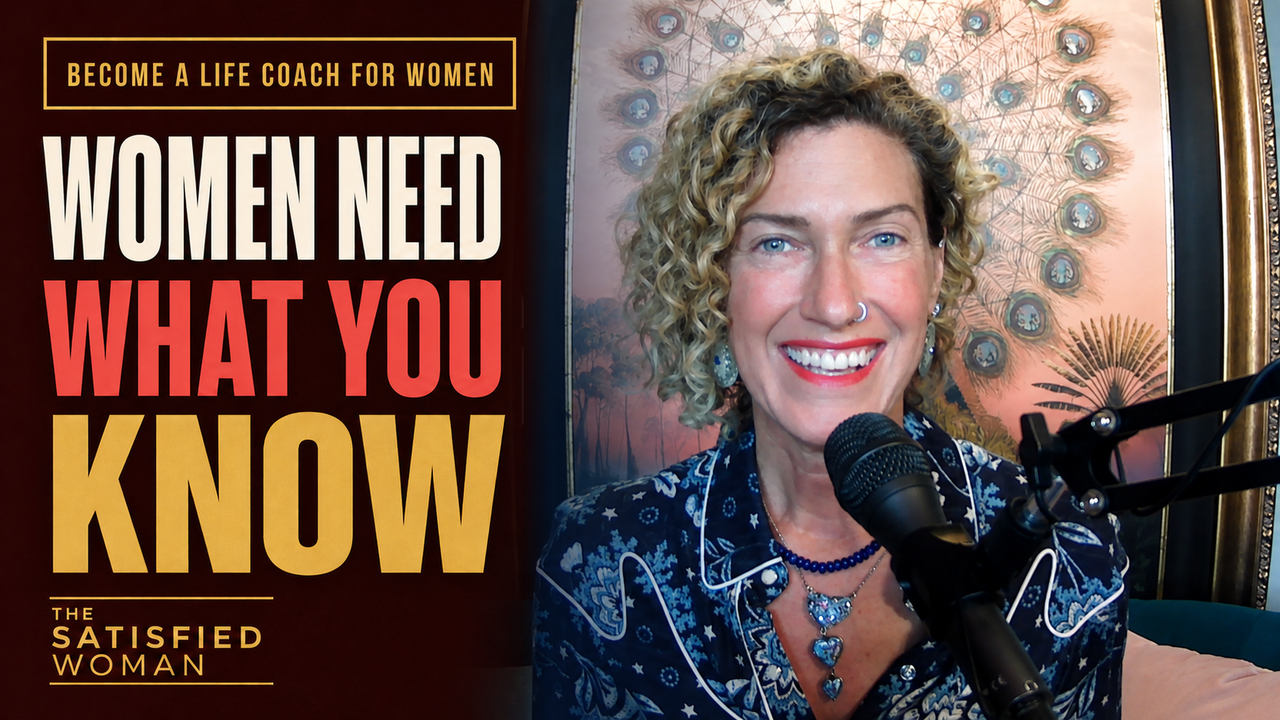
Women Need What You Know.
The Satisfied Method™ Coach Certification is a self-paced professional training grounded in feminine psychology, ethical coaching, and professional transformation. Begin when you are ready and move through the curriculum on your own time, at your own pace—with lifetime access to every lesson and Alanna here to support you throughout.
Enter your name and email to start your free seven-day Open Classroom.
Start watching immediately. No login required.
Your curriculum is released weekly, and every lesson remains available for life.