The Best Books About Masculinity and Masculine Energy for Women
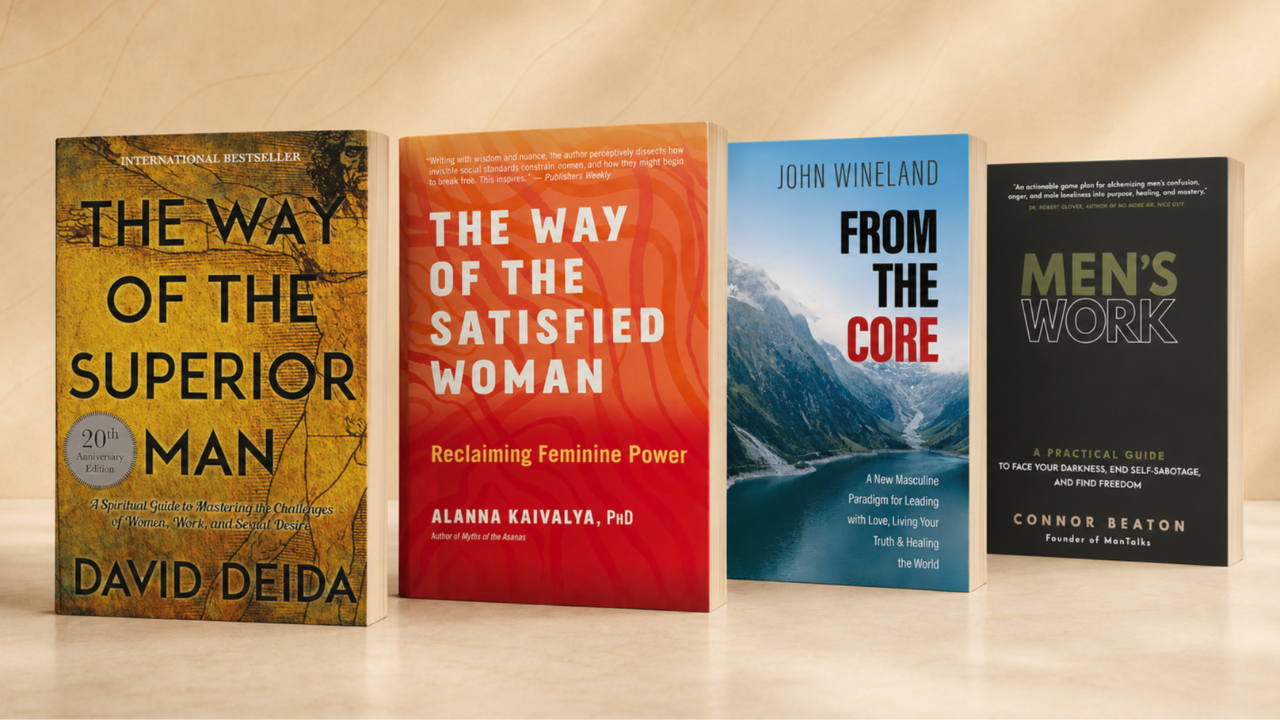
The best books about masculinity and masculine energy for women are the ones that help us understand what healthy masculinity actually is—not what men have been told to perform, and not what women have been trained to tolerate. Start with The Way of the Superior Man, Iron John, and King, Warrior, Magician, Lover for the foundational conversation. Then read From the Core, Man UNcivilized, and Men’s Work for contemporary approaches to masculine integrity, emotional depth, purpose, responsibility, and relationship. Read The Way of the Satisfied Woman alongside them to understand the feminine on its own terms—and why the relationship between masculine and feminine cannot be understood from only one side.
Women are encouraged to read endlessly about relationships, communication, attachment, trauma, dating, and femininity. Yet remarkably few women are ever given a meaningful education in masculinity.
We learn to recognize men through their behavior, but not always through a framework. We are shown caricatures: the dominant man, the emotionally unavailable man, the “nice guy,” the provider, the alpha, the sensitive man, the dangerous man, the passive man. None of those labels gives us a complete picture of mature masculine energy.
Understanding masculinity matters because women live, love, work, parent, negotiate, collaborate, and build lives with men. We need language for the difference between masculinity and domination, strength and control, leadership and entitlement, emotional steadiness and emotional absence.
We also need to understand why so many men are struggling to locate themselves in a culture that has successfully criticized old forms of masculinity without always offering a compelling new model in their place.
Why Women Should Read Books About Masculinity
Learning about masculinity is not about managing men, excusing men, or becoming responsible for their development.
It is about discernment.
A woman who understands healthy masculinity is better equipped to recognize it. She can distinguish groundedness from emotional shutdown or avoidant behavior. She can appreciate masculine direction without surrendering her agency. She can understand the developmental tasks men face without turning herself into their teacher, therapist, mother, or rehabilitation program.
She can also stop interpreting every difference between masculine and feminine experience as evidence that one person is wrong.
Masculine psychology is not simply the psychology of “people who happen to be men.” Men have bodies, developmental experiences, cultural demands, relational wounds, social roles, and rites of passage that shape them. Women do not have to agree with every conclusion in these books to benefit from understanding the questions they ask.
A Woman’s Reading Guide to Masculinity
This is not a list of books women must accept without criticism. It is a map of the modern conversation: where it began, what each author contributes, where the work has advanced, and what women still need in order to understand the masculine without defining themselves through it.
Understanding masculinity sharpens your discernment.
A book can give you language. His behavior tells you whether he can create safety, security, trust, and the experience of being cherished.
The Best Books About Masculinity and Masculine Energy for Women
| Book | Contribution | Why women should read it | Read critically for |
|---|---|---|---|
| The Way of the Superior Man David Deida |
Purpose, polarity, presence, spiritual intimacy, and masculine direction | It established much of the vocabulary still used in modern polarity work | Generalizations about men, women, and polarity rooted in an earlier cultural landscape |
| The Way of the Satisfied Woman Alanna Kaivalya, PhD |
A contemporary feminine psychology of needs, satisfaction, power, sovereignty, and the Four Keys | It gives women their own framework from which to understand and evaluate masculine relationship | It is a feminine counterpart, not a manual for changing men |
| Iron John Robert Bly |
Myth, initiation, the Wild Man, and masculine development | It reveals the grief, longing, and developmental hunger beneath masculine identity | A mythopoetic model shaped by its 1990 context |
| King, Warrior, Magician, Lover Robert Moore and Douglas Gillette |
Four archetypes of mature masculine psychology and their immature shadows | It provides a usable map for recognizing integrated versus distorted masculine power | Archetypes clarify patterns but cannot replace individual evidence |
| From the Core John Wineland |
Embodied masculine leadership rooted in love, integrity, truth, and service | It argues for evolving masculinity rather than erasing it | Energetic language can become abstract if separated from behavior |
| Man UNcivilized Traver Boehm |
The union of primal strength, emotional depth, responsibility, and the “divine” masculine | It speaks directly to men formed inside today’s identity, relationship, and mental-health landscape | Its provocative style is part of the method and will not suit every reader |
| Men’s Work Connor Beaton |
Practical inner work addressing shame, anger, self-sabotage, purpose, intimacy, and emotional health | It translates masculine development into concrete psychological work | Understanding a man’s wounds does not make a woman responsible for resolving them |
1. The Way of the Superior Man by David Deida
Best for: Understanding the foundational modern conversation about masculine purpose, polarity, presence, and intimate relationship.
Published in 1997, The Way of the Superior Man became one of the defining books of contemporary masculine spirituality. Deida wrote about a man’s purpose, his relationship to work, his capacity to remain present with feminine intensity, and the erotic polarity between masculine and feminine partners.
That work mattered because Deida refused to define mature masculinity as brute force, emotional vacancy, or financial status. He linked it to consciousness, integrity, freedom, service, and the ability to remain present in love.
For women, the book offers language for a kind of masculine presence many have experienced intuitively but struggled to name. It also explains why direction, purpose, and groundedness matter so deeply to many men.
But this book is nearly thirty years old. It emerged before social media reorganized identity and courtship, before online dating became ordinary, before contemporary discussions of gender saturated public life, and before women’s economic and relational choices expanded into their current form.
What it illuminates: Masculine purpose, polarity, presence, integrity, and spiritual intimacy.
What it cannot fully answer now: How masculine identity develops amid contemporary loneliness, digital life, shifting family formation, changing gender expectations, men’s mental-health struggles, and women’s vastly expanded agency.
2. The Way of the Satisfied Woman by Alanna Kaivalya, PhD
Best for: Giving women a contemporary feminine framework from which to understand masculinity, relationship, and their own satisfaction.
I named The Way of the Satisfied Woman in direct conversation with The Way of the Superior Man.
Deida asked what it means for a man to live, love, work, and relate from an authentic masculine core. I wanted women to have a framework equally rooted in their own nature—not a derivative answer, not a rebuttal, and not another description of what women should become for men.
Women deserve to understand femininity on its own terms.
That distinction matters when women study masculinity. Without a strong relationship to her own needs, intuition, agency, pleasure, and standards, a woman can turn masculine teaching into another rulebook for accommodating men. She can become so invested in honoring his purpose, wounds, or development that she disappears from the equation.
The Way of the Satisfied Woman establishes the Four Keys of feminine satisfaction: safety, security, trust, and being cherished. Those conditions help a woman evaluate masculine presence through lived evidence. Does this man create greater safety or greater instability? Do his words and actions generate trust? Does his leadership include her wellbeing? Is her femininity cherished, or merely consumed?
What it illuminates: Feminine power, women’s needs, intuition, satisfaction, sovereignty, and the conditions under which the feminine flourishes.
Why it belongs in a masculinity reading list: Masculinity cannot be evaluated in isolation from its effects. Women need their own center of authority while learning about the masculine.
Explore The Way of the Satisfied Woman.
3. Iron John by Robert Bly
Best for: Understanding the mythopoetic men’s movement, masculine initiation, and the longing beneath modern male identity.
Robert Bly uses the Brothers Grimm tale of Iron John to examine a boy’s movement toward manhood. The Wild Man becomes an image of instinct, initiation, grief, vitality, mentorship, and the masculine knowledge that cannot be gained through social approval alone.
Women who read Iron John encounter a dimension of male experience that is rarely visible in daily relationship: the hunger for initiation, the absence of meaningful male mentorship, the grief beneath masculine defenses, and the developmental importance of men learning in the company of men.
The book helped establish the mythopoetic men’s movement, and its influence remains visible across contemporary men’s work.
Its age is also relevant. The economic, familial, technological, and relational landscape surrounding men has changed substantially since 1990. Its mythic insights endure, but its model does not encompass every man or every modern form of masculine life.
What it illuminates: Initiation, mentorship, instinct, grief, masculine identity, and the Wild Man archetype.
What women should remember: A woman can understand a man’s need for initiation without becoming the person responsible for initiating him.
4. King, Warrior, Magician, Lover by Robert Moore and Douglas Gillette
Best for: Recognizing mature masculine archetypes and the distorted shadows that impersonate them.
This Jungian classic identifies four primary patterns of mature masculinity:
- The King brings order, blessing, generativity, and responsible authority.
- The Warrior brings discipline, courage, protection, and decisive action.
- The Magician brings knowledge, skill, reflection, and transformation.
- The Lover brings sensuality, relatedness, creativity, and connection to life.
Each archetype also has immature or inflated forms. Authority can become tyranny. Discipline can become cruelty. Knowledge can become manipulation. Sensitivity can become addiction or chaos.
For women, this is one of the most useful distinctions in the entire field. A man can look powerful while expressing an unintegrated shadow. He can look emotionally expressive while lacking responsibility. He can look protective while exercising control.
The archetypes help us ask a better question than “Is he masculine?” The better question is: What form of masculine power is present, and what happens to the people around it?
What it illuminates: Mature masculine power, archetypal development, inflation, passivity, and shadow.
What it cannot do: An archetypal label is not behavioral evidence. The map supports discernment; it does not replace observation.
5. From the Core by John Wineland
Best for: A contemporary model of masculine leadership that retains masculine difference while rejecting patriarchal domination.
John Wineland’s From the Core, published in 2022, asks an important question: if the old model of patriarchal masculinity must change, does the answer require dismantling masculinity itself?
His answer is no.
Wineland presents masculine development through love, integrity, embodiment, truth, service, and the capacity to become a trustworthy presence. His work inherits part of Deida’s polarity lineage while addressing a world that has become far more suspicious of masculine identity.
This is where the book adds something essential. Men need more than criticism of what masculinity should not be. They need a positive developmental direction—one that does not return to domination and does not flatten masculine and feminine difference into meaninglessness.
For women, Wineland offers a framework for understanding masculine leadership as a practice of presence and service rather than status or control.
What it illuminates: Embodied leadership, integrity, love, service, purpose, and a masculinity capable of evolution.
Where discernment remains necessary: Embodiment and energetic language must be supported by repeatable behavior. Presence is not a claim a man makes about himself; it is something others reliably experience around him.
Ideas about masculinity become useful when you compare them with his behavior.
Use the Relationship Diagnostic to turn what you are learning into clear standards for the man you choose.
6. Man UNcivilized by Traver Boehm
Best for: Understanding a modern masculinity that integrates primal strength, emotional honesty, responsibility, and heart.
Traver Boehm moves the conversation forward by refusing the false choice between the hard, disconnected man and the agreeable, disempowered man.
His “UNcivilized” man seeks access to head, heart, and body. He accepts responsibility. He develops strength without making strength synonymous with domination. He is willing to confront grief, mental health, desire, relationship, purpose, and the parts of himself social respectability taught him to suppress.
This makes the book relevant to women because it addresses the man who exists now—not an imagined man living inside an older family or economic structure. Contemporary men are negotiating greater emotional expectations, changing relationship roles, fractured communities, delayed marriage, fatherhood by choice or not at all, and a culture that gives them conflicting instructions about what manhood requires.
Boehm’s language is intentionally provocative. That directness is part of its appeal and part of what will divide readers.
What it illuminates: Responsibility, primal vitality, vulnerability, purpose, strength, love, and masculine wholeness.
What women should remember: Potential is not the same as practice. A man’s interest in masculine ideas matters less than whether his conduct demonstrates responsibility, integrity, and relational capacity.
7. Men’s Work by Connor Beaton
Best for: A practical, psychologically grounded approach to men’s shame, anger, self-sabotage, purpose, relationships, and emotional life.
Connor Beaton’s Men’s Work brings the field into direct conversation with contemporary psychology. Instead of asking men merely to adopt a stronger identity, Beaton asks them to confront the hidden material directing their behavior.
That includes shame, avoidance, anger, anxiety, self-sabotage, isolation, destructive habits, sexuality, purpose, and the disowned parts of the self.
This is a crucial advance. Masculinity cannot be restored through aesthetics, posturing, income, physical strength, or romantic polarity alone. A man can look traditionally masculine while remaining governed by unexamined fear and shame. He can speak fluently about leadership while avoiding accountability. He can describe himself as protective while refusing the inner work required to become emotionally trustworthy.
For women, Beaton’s work helps explain the internal conflicts many men are navigating without turning those conflicts into excuses.
What it illuminates: Men’s inner work, emotional health, shame, shadow, self-sabotage, purpose, intimacy, and responsibility.
What women should remember: Compassion for a man’s wounds and confidence in his current capacity are two different judgments.
How the Conversation About Masculinity Has Moved Forward
Iron John, King, Warrior, Magician, Lover, and The Way of the Superior Man opened essential doors. They gave modern readers language for masculine initiation, archetype, purpose, polarity, presence, and the wounds created when men are separated from meaningful models of manhood.
But the world surrounding men and women has changed.
Women now possess degrees of economic agency, reproductive choice, professional authority, mobility, and relational choice that were unavailable to most women across history. Many women marry later. Many have children later. Some never marry or never become mothers. Women can build full adult lives that are not structurally dependent upon a husband.
Men are also living inside different conditions. Traditional roles have weakened without being replaced by universally respected rites of passage. Work has changed. Community has changed. Dating has become digitized. Pornography is instantly accessible. Male friendship and mentorship have eroded. Public discussion alternates between romanticizing masculinity and treating it as inherently suspect.
Contemporary writers such as Wineland, Boehm, and Beaton are valuable because they address this new landscape. They ask men to develop emotional depth without surrendering strength, to claim purpose without domination, to take responsibility without collapsing into shame, and to form relationships with women who possess agency, power, standards, and choices of their own.
That is the masculine work of this moment.
On the feminine side, the same evolution is required. Women need more than a female variation on a masculine quest. We need a contemporary psychology that begins with women’s actual lives, needs, bodies, choices, authority, and satisfaction.
That is why The Way of the Satisfied Woman belongs in direct conversation with these books. It does not explain masculinity to men. It gives women the feminine ground from which masculine power can be recognized, appreciated, challenged, chosen, or declined.
What Healthy Masculinity Looks Like in Practice
Across these seven books, a shared picture begins to emerge. Healthy masculinity is not one personality type. It can be forceful or gentle, social or reserved, traditional or unconventional.
But it tends to produce recognizable effects:
- His words and actions become increasingly congruent.
- He takes responsibility without requiring a woman to extract it from him.
- He can remain present with emotion without becoming controlled by it or contemptuous of it.
- He develops purpose, direction, and standards that are larger than immediate gratification.
- His strength increases safety rather than fear.
- His leadership accounts for the wellbeing and agency of others.
- He can protect without possessing.
- He can love without losing himself.
- He does his own developmental work.
This is why women benefit from studying masculinity. We become better able to recognize the real thing—and less likely to confuse charisma, dominance, sexual chemistry, income, intensity, or masculine vocabulary with mature masculine character.
Where Should Women Start?
- For the foundational polarity conversation: Start with The Way of the Superior Man.
- For your own feminine framework: Start with The Way of the Satisfied Woman.
- For myth and masculine initiation: Start with Iron John.
- For mature masculine archetypes and their shadows: Start with King, Warrior, Magician, Lover.
- For embodied masculine leadership: Start with From the Core.
- For primal strength integrated with heart: Start with Man UNcivilized.
- For practical psychological inner work: Start with Men’s Work.
Read these books with both openness and discernment. Let them expand your understanding of men without asking you to organize your life around men. Let them clarify masculine development without turning male potential into evidence of male capacity.
Your next step
Choose the man by what he does.
Download my free Self to Soulmate Relationship Diagnostic to define your non-negotiables, identify the dynamics you keep repeating, and recognize healthy masculine capacity in real life.
Enter your name and email. I’ll send the Relationship Diagnostic immediately.
Most importantly, learn the masculine while remaining rooted in the feminine authority that belongs to you.
Continue exploring: Read the best books on feminine energy and feminine psychology, learn how the feminine and masculine differ, explore masculine and feminine polarity in relationships, or discover what healthy masculinity looks like in a relationship.