The Best Books on Feminine Energy, Divine Feminine Power & Femininity
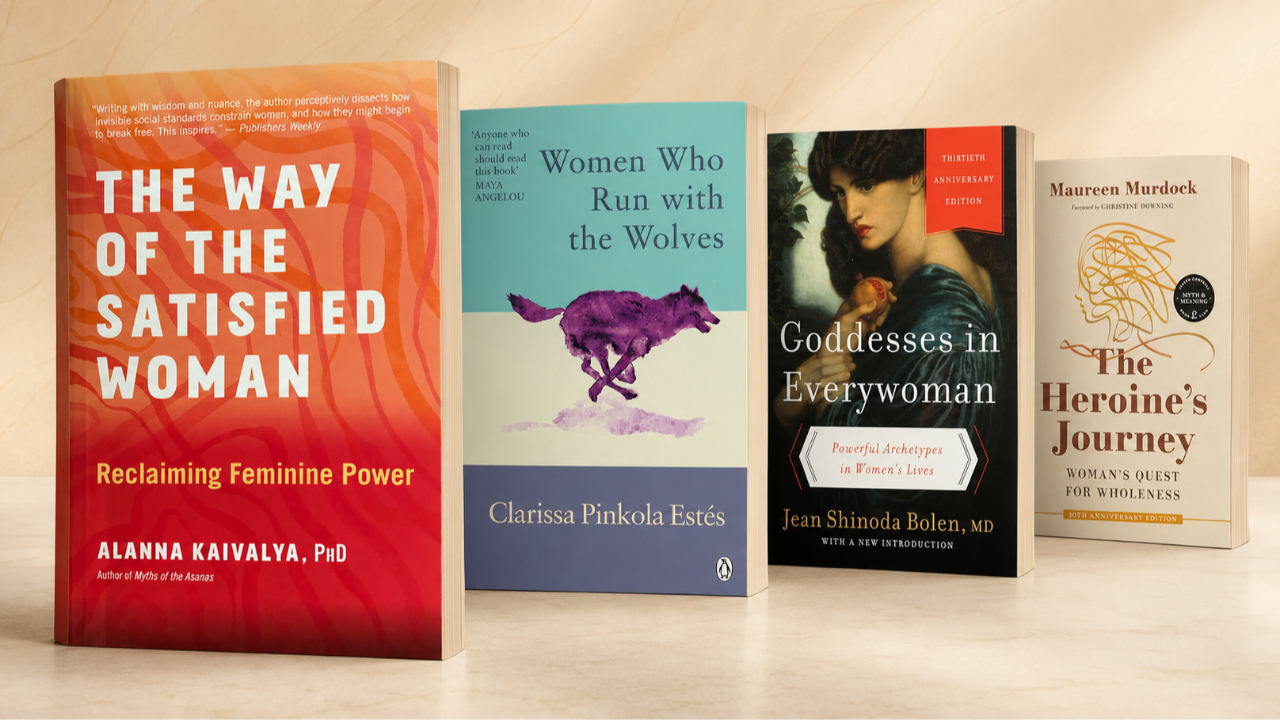
The best books on feminine energy do more than teach a woman how to appear more feminine. They help her understand the feminine psyche, recover instinct and intuition, recognize the cultural forces that shaped her, and translate insight into a life that satisfies her. Start with Women Who Run with the Wolves, Goddesses in Everywoman, The Heroine’s Journey, and The Way of the Satisfied Woman, then choose the deeper psychological or historical works that match the question you are ready to explore.
Search for books about feminine energy and you will find everything from myth and depth psychology to dating rules, manifestation advice, goddess devotion, and instructions for becoming more pleasing to men.
Those books are not all answering the same question.
Some explore the feminine as an archetypal force. Some examine women’s psychology. Some expose the social conditions that separated women from their needs and power. Others offer practices for embodiment, relationships, purpose, or personal transformation.
A useful reading list should tell you which kind of book you are holding—and what it can and cannot give you.
What Makes a Book About Feminine Energy Worth Reading?
A strong book about feminine energy should not reduce femininity to an aesthetic, a performance, or a set of behaviors designed to win approval. It should help a woman understand herself more fully.
The term feminine energy can point toward intuition, emotion, receptivity, creativity, pleasure, relationship, generative power, the unconscious, or the symbolic feminine. Those ideas matter. But energy language becomes useful only when it is connected to the real psychological, relational, cultural, and embodied lives of women.
That is why this list draws from several connected fields:
- Depth psychology and the feminine psyche
- Myth, archetype, and women’s developmental experience
- Feminist cultural analysis
- Contemporary, practical feminine psychology
The central question is not simply, “Does this book celebrate the feminine?” It is: What does this book contribute to our understanding of femininity—and what does a modern woman still need after reading it?
Why This Reading Guide Is Different
Alanna Kaivalya, PhD, is the founder of the Satisfied Method™, a contemporary feminine psychology framework for women’s satisfaction and sovereignty. She holds a doctorate in Mythological Studies with an emphasis in Depth Psychology, has spent more than twenty years studying psychology, mythology, spirituality, and femininity, and is the author of five books, including The Way of the Satisfied Woman.
The right book gives you language for what you already know.
Feminine psychology becomes useful when insight changes your decisions, relationships, work, and relationship with yourself.
The Best Books on Feminine Energy, Power, and Psychology
| Book | Central contribution | Best for | What you will still need |
|---|---|---|---|
| The Way of the Satisfied Woman Alanna Kaivalya, PhD |
A contemporary framework for women’s needs, satisfaction, feminine power, relationships, sovereignty, and the Four Keys | The woman who wants insight translated into decisions and daily life | Deeper immersion in archetypal stories and the history of women’s liberation |
| Women Who Run with the Wolves Clarissa Pinkola Estés, PhD |
The instinctual feminine psyche revealed through myth, fairy tale, and story | The woman who feels separated from instinct, creativity, or inner knowing | A concise structure for modern choices, relationships, and material life |
| Goddesses in Everywoman Jean Shinoda Bolen, MD |
Seven Greek goddess archetypes as patterns in women’s personalities and lives | The woman who wants language for competing inner drives and identities | A framework beyond archetypal categories and inherited cultural roles |
| The Heroine’s Journey Maureen Murdock |
A developmental path from identification with masculine values toward integration and wholeness | The accomplished woman who senses that achievement has cost her something essential | Practical standards for satisfaction, boundaries, receiving, and relationship |
| The Pregnant Virgin Marion Woodman |
Psychological transformation and the woman who becomes “one in herself” | The experienced reader drawn to Jungian depth work and symbolic transformation | A more accessible bridge from symbolic insight to ordinary life |
| The Way of Woman Helen M. Luke |
Jungian reflections on feminine worth, relationships, marriage, divorce, community, and mothering | The reflective reader who wants mature psychological and spiritual essays | A unified method for applying the insights across modern womanhood |
| The Feminine Mystique Betty Friedan |
A landmark cultural diagnosis of women’s confinement and dissatisfaction | The reader who wants historical context for modern women’s expectations | A fuller account of diverse women’s lives and an affirmative psychology of femininity |
1. The Way of the Satisfied Woman by Alanna Kaivalya, PhD
Best for: Women who want a contemporary, practical framework for feminine psychology and a life measured on their own terms.
The Way of the Satisfied Woman: Reclaiming Feminine Power begins with a proposition that changes the entire conversation: femininity has its own qualities, its own standards, and its own realm of satisfaction.
The book does not ask women to reject achievement, independence, logic, or masculine capacity. It asks why so many capable women have built lives that work on paper while remaining exhausted, disconnected, under-supported, or deeply unsatisfied.
Its answer is not another performance of femininity. It is a framework built around women’s actual needs. Satisfaction is defined as the pleasure derived from the fulfillment of one’s wishes and needs. The Four Keys—safety, security, trust, and being cherished—identify the conditions that allow the feminine to flourish. The book then applies those principles to intuition, psychological wounds, relationships, motherhood, work, money, success, sovereignty, and a woman’s development across her life.
What it illuminates: Why insight alone does not create satisfaction; why women’s needs are not defects; how cultural training pushes women into masculine overdrive; and how a woman can use intuition, emotion, discernment, relationship, and sovereignty as practical forms of power.
What it does not try to be: An encyclopedic history of feminine archetypes or an exhaustive account of feminist theory. Its work is application: giving a modern woman an organized path from understanding to living differently.
Explore The Way of the Satisfied Woman.
2. Women Who Run with the Wolves by Clarissa Pinkola Estés, PhD
Best for: Women who feel estranged from instinct, creativity, desire, or the part of themselves that refuses domestication.
This foundational work of feminine depth psychology uses myths, fairy tales, folk tales, and stories to examine what Estés calls the Wild Woman: the instinctual nature that remains alive beneath social conditioning.
Its power lies in story. Rather than reducing the psyche to instructions, Estés lets symbolic narratives work on the reader. The book restores dignity to the fierce, creative, discerning, life-giving dimensions of women that have been disciplined into compliance or dismissed as excessive.
What it illuminates: The intelligence of instinct, the cost of severing women from their inner knowing, and the psychological function of myth as a route back to the soul.
What it leaves unanswered: How to organize that awakening into clear standards for relationships, money, boundaries, support, and satisfaction. It opens the door to the instinctual psyche; the modern woman still needs a structure for living what she finds there.
3. Goddesses in Everywoman by Jean Shinoda Bolen, MD
Best for: Women who want to understand the different archetypal drives active within them.
Bolen, a psychiatrist and Jungian analyst, uses seven Greek goddesses as patterns for understanding personality, motivation, relationships, vocation, sexuality, and development. Athena, Aphrodite, Artemis, Hera, Demeter, Persephone, and Hestia become more than figures from ancient religion; they become symbolic maps for recognizable forces in women’s lives.
The book is especially useful when a woman feels pulled in several directions. The part of her devoted to achievement can conflict with the part that longs for partnership. The mother can eclipse the sovereign woman. The lover, strategist, mystic, and protector can each want something different.
What it illuminates: Why women are not psychologically interchangeable, how archetypes shape choices, and how myth gives language to inner conflict.
What it leaves unanswered: Archetypes can clarify a pattern without telling a woman whether the pattern satisfies her. A modern framework must also account for her body, personal history, cultural conditions, needs, choices, and standards.
4. The Heroine’s Journey by Maureen Murdock
Best for: The accomplished woman who has succeeded according to masculine standards and senses that something essential was lost along the way.
Murdock offers a female-centered response to the heroic model of development. Her heroine begins through identification with masculine values, experiences the cost of that identification, descends toward the feminine, and seeks integration rather than conquest.
This makes the book especially relevant for women who have learned to derive worth from productivity, mastery, endurance, and external approval. It gives symbolic structure to the experience of reaching the promised destination and discovering that achievement did not create wholeness.
What it illuminates: The psychological cost of defining maturity through masculine achievement and the need to reclaim rejected feminine values.
What it leaves unanswered: A developmental map does not automatically tell a woman how to change the conditions of her current life. She still needs concrete language for needs, boundaries, receiving, relationship, discernment, and satisfaction.
Take the ideas off the page and into your life.
The Feminine Reset turns feminine insight into an immediate practice of truth, discernment, and receiving.
5. The Pregnant Virgin by Marion Woodman
Best for: Readers ready for demanding Jungian work on psychological transformation and the deep feminine.
Woodman’s title invokes the woman who is “one in herself”: a woman whose actions arise from inner truth rather than the pursuit of power or the desire to please. Through clinical material, literature, religion, art, and symbolism, Woodman examines what it means for a woman to give birth psychologically to herself.
This is not an introductory book about feminine energy. It belongs to the deeper end of the pool. Its language is symbolic, its psychological work is exacting, and its concern is transformation rather than lifestyle.
What it illuminates: The difference between female identity organized around approval and a feminine self grounded in inner authority.
What it leaves unanswered: Readers seeking immediate application will need a bridge between Jungian symbolism and the specific decisions of contemporary work, love, money, and daily life.
6. The Way of Woman by Helen M. Luke
Best for: The reflective reader who wants mature Jungian writing on feminine worth across the span of a woman’s life.
Luke writes about community, relationships, marriage and divorce, mothering, and the women’s movement through the lens of feminine psychological and spiritual development. The book’s value lies in its refusal to treat femininity as a trend or technique. It approaches the feminine as a lifelong source of wisdom and meaning.
What it illuminates: The relationship between feminine worth, symbolic life, maturity, and the ordinary human experiences through which a woman comes to know herself.
What it leaves unanswered: Its essays offer depth and reflection more than a single applied method. A reader will still need to translate its wisdom into her own standards and actions.
7. The Feminine Mystique by Betty Friedan
Best for: Readers who want historical context for the dissatisfaction produced when women are confined to prescribed roles.
Published in 1963, The Feminine Mystique named a form of discontent that many women had been taught not to articulate. Its importance is cultural and political: it exposed the gap between the idealized image of womanhood and the lives of women who felt diminished inside it.
Its limitations matter, too. The book centered a narrower group of women than its universal language acknowledged, and later feminist scholarship expanded the field through race, class, sexuality, labor, and other dimensions of women’s experience.
What it illuminates: How social ideals can train women to distrust dissatisfaction and organize their lives around roles that deny their agency.
What it leaves unanswered: Exposing a restrictive definition of womanhood does not by itself provide an affirmative psychology of femininity. Liberation from a role is essential; women also need language for what they are moving toward.
Why Contemporary Feminine Psychology Must Go Beyond “Feminine Energy”
“Feminine energy” is useful language, but it can become so broad that it loses explanatory power.
When femininity is reduced to receptivity, flow, sensuality, clothing, dating conduct, or spiritual identity, the burden lands on the woman to perform the right state. Her real circumstances disappear. Her psychological wounds disappear. Her relationships, developmental history, material security, cultural training, and unmet needs disappear.
A woman cannot perform her way into trust. She cannot dress her way into safety. She cannot become receptive inside a relationship that repeatedly proves unreliable. She cannot meditate herself into satisfaction while denying the truth of her own needs.
Contemporary feminine psychology places energy inside a larger system. It asks:
- What is happening in this woman’s inner and outer life?
- What has she learned to dismiss, perform, endure, or override?
- What does her intuition know?
- What do her emotions communicate?
- Are the Four Keys of safety, security, trust, and being cherished present?
- What would actually satisfy her?
That is the movement from an appealing idea about femininity to a psychology capable of changing a woman’s life.
Where Should You Start?
Choose the book that matches the question already alive in you:
- If you want a practical framework for feminine satisfaction: Start with The Way of the Satisfied Woman.
- If you want to recover instinct and imagination: Start with Women Who Run with the Wolves.
- If you want to understand your archetypal patterns: Start with Goddesses in Everywoman.
- If achievement has left you depleted: Start with The Heroine’s Journey.
- If you are ready for deep symbolic transformation: Start with The Pregnant Virgin.
- If you want mature Jungian reflection: Start with The Way of Woman.
- If you want historical context for women’s dissatisfaction: Start with The Feminine Mystique.
No single book can contain the full field. Taken together, these works show the progression clearly: from cultural diagnosis, to archetypal understanding, to psychological transformation, to the practical work of building a life that fulfills a woman’s wishes and needs.
Your next step
Begin living what you have been reading about.
Download my free Feminine Reset to interrupt automatic doing, reclaim your Sacred No, and reconnect with the feminine authority these books help you name.
Enter your name and email. I’ll send the Feminine Reset immediately.
Continue exploring: Read What Is Feminine Psychology?, learn how to increase feminine energy without performing it, or discover The Way of the Satisfied Woman.
For practitioners: If you want to help other women apply this work with psychological depth, ethical structure, and a reproducible method, explore feminine coaching certification through the Satisfied Method™.