How to Stop Putting Everyone Else First and Start Living Your Life
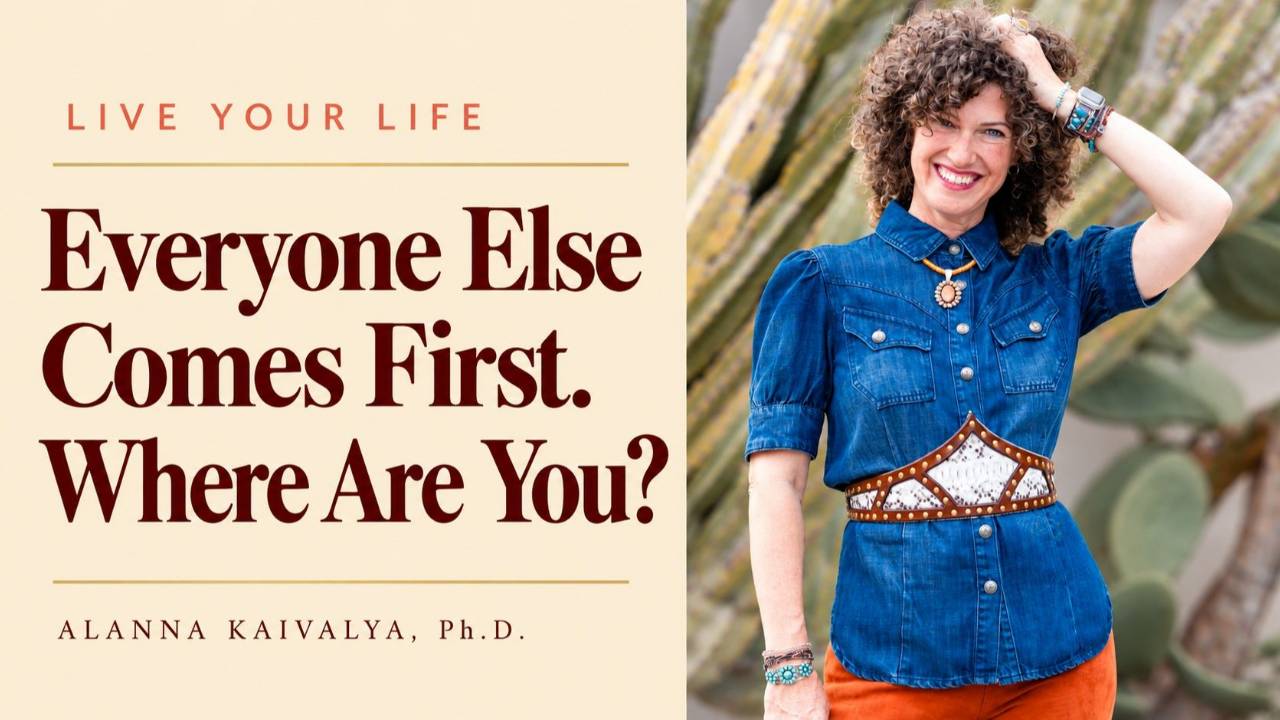
You take care of everyone else. Your partner, your family, the people who depend on you professionally. Even when you look for help, you find yourself asking what else to add: more meditation, another practice, a better way to manage everything.
What if making your life better begins with taking something off your plate?
You know you don't want to cook every night. You've said it to yourself a hundred times. Tonight, you even say it out loud.
Then no one else starts dinner.
You think about what he'll eat. Whether he'll be disappointed. Whether it's easier to get up and do it than sit here feeling guilty. Before long, you're back in the kitchen, resenting the very thing you just agreed to do again.
You understood the problem. You knew your answer. What happened?
Your no never became something you lived.
Learning how to stop putting everyone else first means bringing your own needs into the choices you actually live. A realization gives you something to act on. Feminine transformation happens as your life begins to reflect it.
Your yes and no need consequence
Consequence means your answer changes your participation. Your no protects the time, energy, attention, or access you've decided to withhold. Your yes brings you into an experience you actually want.
If you say you're no longer available to cook every night, some evenings need to unfold without you cooking. Someone else takes responsibility. Dinner is ordered. Another capable adult figures out how to feed himself.
When you keep rushing in, everyone returns to the same arrangement. Your words said no. Your behavior kept saying yes.
That gap is incongruence. What you know and feel on the inside doesn't match what you express and live on the outside. You end up participating in a life that contradicts you.
Congruence brings those together. The no you feel becomes the no you live. The yes you feel becomes the yes you live. There is authenticity in the way you participate, and other people finally have the opportunity to know the woman who is actually there.
Let your own answer change your life.
Explore the feminine psychology that helps you honor your intuition—and learn to guide other women toward their own sovereignty.
What happens when you keep overriding yourself?
Someone asks for something, and your intuition says no. You answer yes anyway. That person believes you've agreed. They're responding to the answer you've given, while you're living with the answer you've denied.
Now you're resentful. Their next request irritates you before they've finished asking. You start avoiding them. You feel exhausted by the relationship, and eventually you stop expecting anything different from it.
Resentment grows in that gap. Contempt and apathy find room there, too. You're performing agreement while something inside you is protesting.
That is a betrayal of your own knowing. It also prevents an authentic connection: the other person is relating to the woman who keeps saying yes, while the woman who means no remains unheard.
This doesn't make you responsible for someone else's mistreatment. Their conduct belongs to them. Your opportunity is to recognize where you still have a choice about your participation and let your own answer enter the relationship.
We live in a culture that has rewarded women for being agreeable, helpful, and endlessly available. For plenty of women, disappointing someone has felt like a threat to love, safety, or belonging. We have to understand that history if we want her next choice to be different.
More to do won't answer what your life is asking
A woman comes for help because she's burned out, and she leaves with a new morning routine, a meditation assignment, and another journal. Now she has more to accomplish before she gets to begin the day that already exhausts her.
Those practices have their place. The question is whether we've understood what is exhausting her.
Has anyone asked if she wants the life she's maintaining? Does she know what she needs? What happens when she imagines refusing the next demand? Whose definition of success is she still trying to satisfy?
There's nothing worse than climbing the ladder and realizing you've put it against the wrong wall. Getting better at climbing doesn't solve that problem.
Feminine psychology brings the woman herself into the inquiry. Her intuition. Her emotional depth. The desires she's dismissed. The girl who learned to be agreeable. The role she keeps playing because she's afraid of what happens if she stops.
We look at the inner decisions that keep making the old arrangement feel necessary. Then we bring the wise adult woman's agency into choosing what happens next.
The journey takes you inward—and asks you to return
In mythology, the hero leaves the familiar world, crosses a threshold, encounters what challenges everything they thought they knew, and returns changed. The journey offers us a way to understand our own transformation.
For a woman, that familiar world includes the expectations she's inherited. Be a good wife. Be a good mother. Be useful. Be grateful. Be the woman who handles everything.
Then something becomes impossible to ignore. She realizes she doesn't want the arrangement anymore. The success she's worked for leaves her dissatisfied. The relationship asks her to give up too much of herself. The life that looked right from the outside doesn't feel right to her.
Crossing the threshold means being willing to examine it. What has she accepted as true? What does she actually want? What identity feels threatened when she says no?
She encounters the younger girl who learned that everyone's happiness was her responsibility. She discovers how little room her own wishes have had. She recognizes the intuition she's been arguing against.
That recognition is consequential. The next movement is bringing it back into her relationships, her decisions, and her daily life.
She returns to the same kitchen. The same request. The same person who expects the familiar answer. This time, she has a different answer—and the opportunity to live it.
Boundaries are actions
A boundary describes how you participate and what you do when the terms of that participation are crossed. Its power lives in your ability to follow it.
Think about the woman who needs honesty in her relationships. She expresses that need clearly. If deception continues, she decides what access this person has to her. She changes her participation, seeks support, or leaves the relationship.
Repeating how important honesty is while accepting the same dishonesty leaves the arrangement in place. Her need has been explained. It hasn't yet changed what she accepts.
This is where your Sacred Yes and Sacred No give your feminine vessel its structure. You decide what you receive, what you participate in, and what no longer has access. That structure protects the life you're trying to create.
Changing your participation also means considering the circumstances in front of you. A difficult conversation with a dependable partner and a confrontation with someone who threatens you call for different responses. Protecting yourself includes practical planning and outside support when needed.
The question is what action honors your knowing in your actual life. Your boundary belongs to you. Another person's decision belongs to them.
Someone else's disappointment doesn't erase your answer
"You used to always say yes."
Of course they noticed. The old arrangement worked for them. Now they're being asked to participate differently, and their response gives you information.
Some people will welcome the clarity. Some will need a conversation about how you move forward together. Some will keep asking you to return to the version of yourself who never had a limit.
You get to hear their feelings without automatically surrendering your answer. You're able to discuss a shared responsibility while remaining clear about what you're willing to do. A conversation becomes useful when the woman having it stays present in the agreement.
Feminine guilt arrives before anyone has even responded: What will he think? Will she be upset? Will they still love me? You begin managing an anticipated reaction, and your own need disappears.
Recognizing that guilt gives you a choice. You let the feeling be there while you honor what you know. You stop treating someone else's disappointment as proof that your boundary is wrong.
Their response is theirs. What you do with it is yours.
Your yes deserves a future.
See the education that helps you change your life, develop your gifts, and build a coaching practice for women.
Your sacred yes needs a life, too
Transformation also asks you to receive the things you've wanted and kept postponing.
You want to study something that excites you. You want a relationship that feels good. You want to dance, create, teach, or build a practice of your own. You know the yes. Then everyone's needs arrive, and yours go back to the end of the list.
Living the yes means giving it time and participation. You arrange the support. You make the decision. You show up for the thing you said you wanted.
Your no preserves room for that yes. Together, they let your wishes and needs have consequence. Your life begins to offer the fulfillment you've been trying to reach through doing more.
Satisfaction is the pleasure derived from the fulfillment of your wishes and needs. Those wishes and needs have to enter the life you actually live.
Embodiment is living what you know
A movement practice gives you an opportunity to feel your body. Feeling your yes and no helps you recognize your intuition. Embodiment extends into how you live once the practice is over.
When the request comes, you honor your answer. When your body tells you no, you stop supplying reasons to ignore it. When something delights you, you let that desire influence a real decision.
That's the congruence we're after: the woman on the outside living what the woman on the inside knows.
There will be moments when the old response returns. You hear yourself agreeing before you've considered what you want. You notice the guilt and rush to make someone comfortable. That recognition gives you a place to return to your answer and make another choice.
Lasting change grows through living those choices. You experience yourself as a woman who knows her needs and acts on their behalf. Your relationships begin to reflect who you are willing to be within them.
Imagine helping another woman make that return
Once you've lived this, you hear a different conversation when a woman tells you she's exhausted. You listen for where her no disappears. Where her yes keeps waiting. What she believes she'll lose if her life begins to honor her.
You understand why another task won't reach the whole problem. You know how much courage it takes to change the agreement and stay with that choice when someone protests.
This is the education I want women to have. An understanding of our feminine psychology, the cultural expectations we've inherited, and the unconscious decisions that keep directing our lives. A way to bring that understanding into decisions that change how we live.
That's why I created The Satisfied MethodTM Coaching Certification. You learn this for your own life and develop the skill to guide other women through the same kind of transformation. We bring together the framework, practice, professional discernment, and mentorship that help you become a capable coach.
I'm the founder of the method and your mentor throughout the training. Learn to change a woman's life. Start with yours.
Change your life. Learn to change the lives of other women.
Take a free seven-day look inside The Satisfied MethodTM Coaching Certification. Watch a teaching and a real coaching demonstration, meet Alanna, and explore the complete training.
Enter your name and email for immediate access.
Keep exploring
- Why Women Need to Learn Feminine Psychology
- How to Say No Without Feeling Guilty
- How to Reparent Yourself
- What Does Emotional Safety Feel Like? Discover Your Safe Energy Signature
- The Four Keys to Feminine Satisfaction
Alanna Kaivalya, Ph.D., is an author, educator, founder of The Institute for Feminine Psychology, and creator of The Satisfied MethodTM Coaching Certification.