The Four Keys to Feminine Satisfaction: Safety, Security, Trust, and Being Cherished
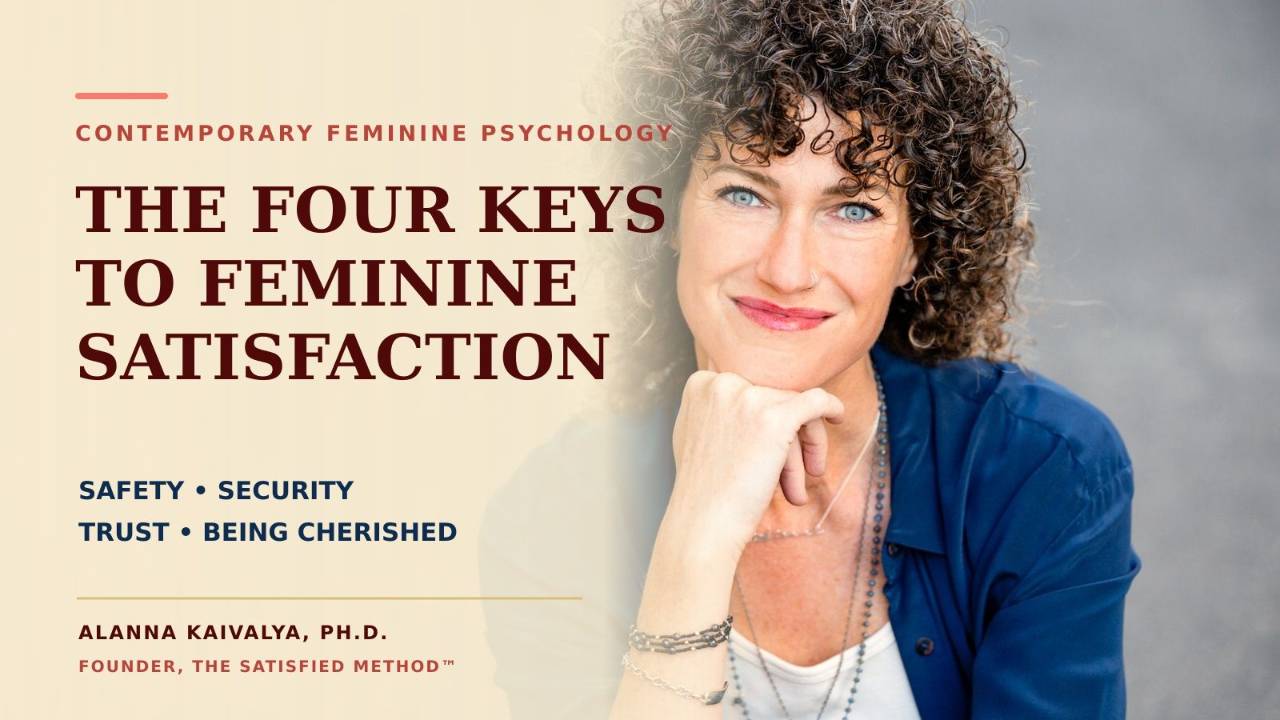
Satisfaction is not a gold star you receive for doing everything correctly.
It is not the career, marriage, home, body, or reputation that proves you succeeded according to somebody else's standards.
Satisfaction is the pleasure you feel through the fulfillment of your wishes and needs.
That definition places a woman's actual life back at the center of the inquiry. Not what she accomplished. Not how much she handled. Not whether everyone around her is comfortable.
Are her wishes and needs being fulfilled? Does her life create pleasure, support, freedom, connection, and enoughness? Can she be fully herself inside it?
In The Satisfied Method™, four foundational conditions make that satisfaction possible: safety, security, trust, and being cherished.
These are the Four Keys to Feminine Satisfaction.
They are not rewards a woman earns after becoming less demanding, more productive, easier to love, or better at doing everything herself. They are the psychological conditions that allow her to leave survival mode, regain access to her feminine intelligence, and build a life that can actually satisfy her.
Watch the original Episode 17 teaching on the Four Keys.
Why satisfaction requires a foundation
A woman cannot devote herself fully to creativity, desire, intimacy, or meaningful work while her nervous system is scrambling to establish basic safety.
She cannot hear her intuition clearly when her attention is consumed by instability.
She cannot receive support while expecting that every need will eventually become her responsibility.
She cannot thrive in relationships where her perception is continually dismissed or where she is left alone inside her pain.
This is why the Four Keys are not inspirational ideals. They are structural.
When they are absent, a woman adapts. She manages more. She anticipates problems. She becomes hyper-independent. She overrides her emotions. She lowers her expectations. She stops asking for what she needs because needing anything has become dangerous, disappointing, or exhausting.
Those adaptations can make her look remarkably competent.
They do not make her satisfied.
The Four Keys help us identify what must be present before a woman can stop organizing her life around survival and begin organizing it around fulfillment.
Satisfaction begins when your life fulfills your actual needs.
Safety, security, trust, and being cherished give you a practical way to evaluate the life you are living.
The First Key: Safety
Safety is the ability to be fully yourself without threat of harm.
Physical safety matters, of course. But feminine psychological safety is broader. It includes the ability to tell the truth, express an emotion, set a boundary, change your mind, name a desire, or reveal who you are without expecting punishment, ridicule, abandonment, or retaliation.
A safe home is not merely one with a locked door. It is a place where your nervous system understands that you can stop performing.
A safe relationship is not merely one without overt violence. It is one in which your personhood is not treated as a problem to manage.
A safe workplace is not merely one that complies with policy. It is one in which you can contribute without continually armoring yourself against humiliation, exploitation, or erasure.
The masculine counterpart to safety is protection.
That protection can come from the trustworthy people and structures around you. It can also come from your own internal masculine capacity: the part of you that draws the boundary, ends the conversation, makes the plan, locks the door, documents the behavior, or removes access.
Protection does not require a woman to live permanently inside armor. Its purpose is to establish the conditions in which her fullness can safely return.
Ask yourself:
- Where can I be completely myself?
- Where do I edit, shrink, perform, or brace?
- What person, boundary, resource, or decision would create meaningful protection?
- What have I called “normal” that my body experiences as unsafe?
The Second Key: Security
Security is the reliable knowledge that what you need will be available.
Food. Shelter. Money. Time. Consistency. Care. Commitment. Information. Support. The specific resources will differ across women and across stages of life, but the psychological function is the same: security tells the nervous system that the essentials will not vanish without warning.
The masculine counterpart to security is provision.
Provision is not limited to a male partner earning money. It is the function that creates and maintains dependable resources. A retirement account can provide security. A reliable income can provide security. A committed partner can provide security. A community, legal agreement, savings plan, calendar, home, or well-designed business can provide security.
Women can and do provide for themselves. But feminine psychology asks us to notice the cost when a woman must remain the sole provider of every material, emotional, logistical, and relational need in her world.
Hyper-independence is frequently praised as empowerment because it produces competence. Yet competence without support can become an endless private emergency.
Security gives a woman enough ground beneath her feet to imagine more than survival.
Ask yourself:
- What do I need to know will be there tomorrow?
- Which forms of inconsistency keep me activated?
- Where am I providing everything while receiving almost nothing?
- What practical structure would allow me to exhale and create?
The Third Key: Trust
Trust begins inside the woman and extends into the world around her.
She needs access to her own perception, intuition, emotions, judgment, and capacity to respond. She also needs relationships and circumstances whose behavior demonstrates integrity.
Within contemporary feminine psychology, a woman's intuition is her primary form of knowing. She can check that knowing against logic, evidence, context, and experience. Logic helps her interpret and act upon what intuition reveals; it is not the source from which her deepest knowing originates.
When a woman has been repeatedly told that she is irrational, dramatic, too sensitive, or wrong about what she observed, she may learn to cross-examine herself before evaluating the person or situation that caused her concern.
That is not discernment. It is destabilization.
Trust in others is not created by promises, chemistry, authority, or insistence. It is established through repeated congruence.
A trustworthy person considers your well-being as they act. A trustworthy relationship can withstand truth. A trustworthy institution behaves consistently with its stated values.
Trust can sometimes be repaired after a breach. It cannot be demanded in the absence of evidence.
Ask yourself:
- What did I know before I talked myself out of it?
- Where has repeated behavior earned my trust?
- Where am I granting trust because someone expects it?
- What evidence would repair this breach—and has that evidence actually appeared?
The Fourth Key: Being Cherished
To be cherished means that your emotions and intuition matter and that you are not abandoned inside your pain.
Cherishing is not flattery. It is not pedestal language. It is not a declaration that a woman is a “goddess” while her actual needs remain inconvenient.
Cherishing is behavioral.
It is the decision to turn toward a woman when she is hurting rather than dismissing, correcting, mocking, minimizing, or leaving her alone in the experience.
The masculine counterpart to being cherished is presence.
Presence says: I see that something is happening. I will not override your experience to preserve my comfort. I will stay engaged long enough to understand what this means and what repair or support requires.
A woman can develop an internal masculine capable of cherishing her feminine life. She can stop abandoning herself the moment an emotion becomes inconvenient. She can honor what she knows, protect what matters, and refuse to collaborate in her own dismissal.
But internal cherishing does not make relational cherishing unnecessary. Women are relational beings. We need people whose behavior proves that our interior lives matter.
Ask yourself:
- Who turns toward me when I am in pain?
- Who makes my emotional reality into an inconvenience?
- Where do I abandon myself before anyone else has the opportunity?
- What would cherishing look like as observable behavior?
Find the Key your life is asking you to restore.
The Feminine Reset helps you see which need has been pushed aside while you handled everything else.
The Four Keys work together
The Four Keys are distinct, but they are not separate compartments.
Without safety, trust becomes dangerous.
Without security, the nervous system remains occupied by scarcity.
Without trust, support cannot be received with confidence.
Without being cherished, a woman learns that her emotions and intuition will cost her connection.
The sequence matters, too. A woman told to “be more feminine” while living without safety or security is being asked to become more open inside conditions that have not earned her openness.
A woman told to trust while evidence remains inconsistent is being trained to override herself.
A woman told to receive while surrounded by people who punish need is not failing at feminine energy. Her system is accurately reading the environment.
This is one reason pop feminine-energy advice can become so damaging. It turns structural conditions into a performance problem. It tells the woman to change her tone, clothes, posture, or dating strategy while ignoring the psychological foundation required for genuine receptivity.
The Four Keys bring us back to reality.
The Four Keys in love, work, money, and power
The same framework applies across a woman's life.
In love, the Four Keys help her distinguish chemistry from compatibility and attention from care.
At work, they reveal whether achievement is supported by fair structures or extracted through over-functioning.
Your next step
Put your satisfaction back at the center of your life.
Download my free Feminine Reset to identify what is missing, hear your truth, and take one immediate step toward a life that fulfills you.
Enter your name and email. I’ll send the Feminine Reset immediately.
With money, they expose the difference between income as a status marker and resources as a foundation for choice.
In power, they separate sovereignty from isolation. A sovereign woman is not a woman who needs no one. She is a woman whose life is not controlled by the threat that her necessities, safety, perception, or belonging will disappear if she tells the truth.
The Four Keys are therefore both personal and diagnostic. They help a woman name what is missing without turning that absence into a defect in herself.
How to begin assessing your Four Keys
Do not begin by asking whether your entire life is safe, secure, trustworthy, and cherishing. That question is too broad to produce useful information.
Choose one domain: partnership, work, friendship, home, money, family, or your relationship with yourself.
Then assess each key with evidence:
- Safety: Can I be fully myself here without credible threat of harm?
- Security: Are the things I need reliably available?
- Trust: Do behavior and evidence support confidence in myself and the people or structures involved?
- Being cherished: Are my emotions and intuition treated as meaningful, especially when I am in pain?
Notice where the answer is clear. Notice where you immediately begin explaining away the evidence.
You do not have to solve every gap today. But you cannot build satisfaction around conditions you refuse to name.
The Four Keys inside The Satisfied Method™
The Four Keys form part of the foundation of The Satisfied Method™, a contemporary feminine-psychology framework for women's satisfaction and sovereignty.
The method begins with women on our own terms: our embodied, developmental, relational, emotional, intuitive, and cultural experience. It does not ask women to become better at tolerating lives that exclude their wishes and needs.
It asks a more consequential question:
What would need to become true for this woman to be satisfied?
Understanding that question can transform your own life. Learning to facilitate it can transform the lives of other women.
If you feel called to guide other women through this work, explore The Satisfied Method feminine coaching certification. You can see the methodology, enter the free Open Classroom, and determine whether this is the professional work you are ready to learn.
The Four Keys are not an impossible standard.
They are a way of telling the truth about what women require to flourish—and a place to begin building it.
Your Professional Next Step
Learn the method. Become the coach women are looking for.
If the Four Keys give language to the work you already know you are here to do, explore The Satisfied Method™ Coaching Certification and learn to facilitate this feminine-psychology framework professionally.
Step inside the free Open Classroom to experience The Satisfied Method™ Coaching Certification: a full practitioner lesson, a real coaching demonstration, and your curriculum preview.