ICF vs. Non-ICF Coaching Certification: Choose for Competence
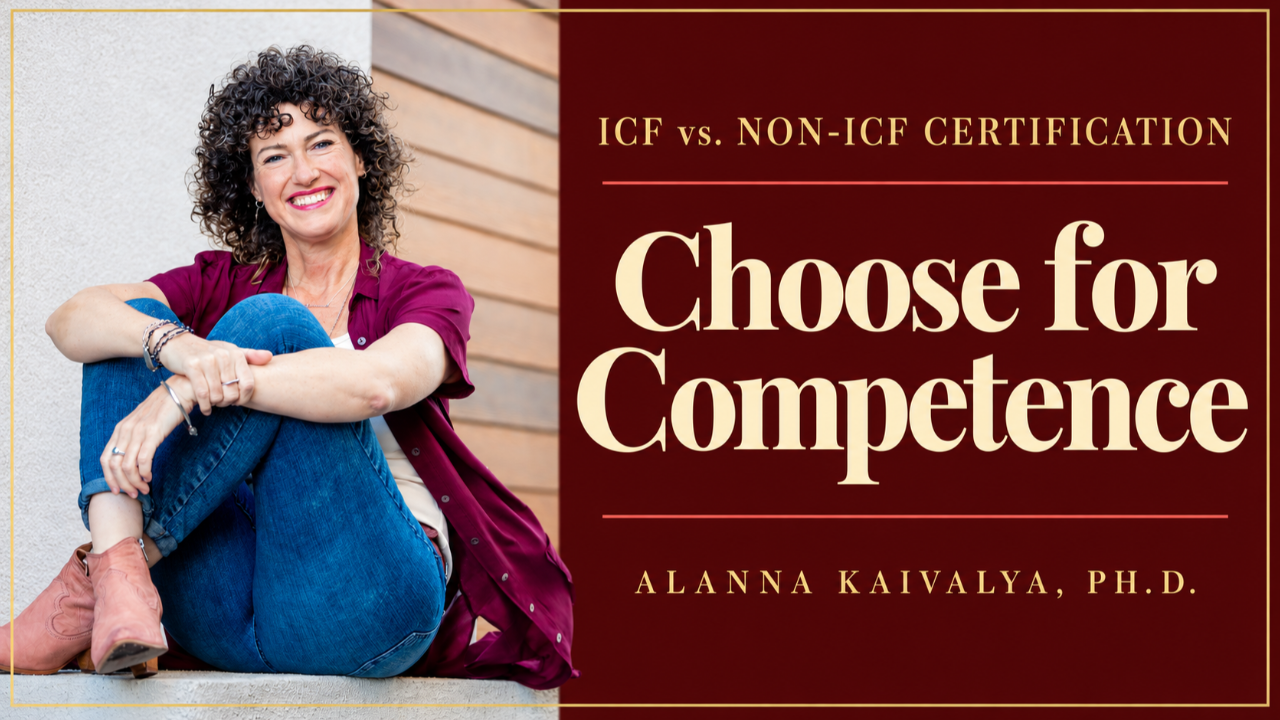
When comparing ICF and non-ICF coaching certification, the most consequential question is what the program teaches you to do. Coaching is a largely unregulated field. ICF is a professional organization that accredits education and awards credentials according to its own standards. Its accreditation is one way to evaluate a program. The actual education, practice, feedback, and mentorship tell you how that program prepares you for the women you want to help.
Because a woman’s life is on the other side of this education. She’s going to come to you with something she hasn’t been able to change, and the letters after your name won’t conduct that conversation for you.
Your understanding will. Your skill will. Your ability to hear what’s happening underneath her explanation and help her do something different will.
We’re choosing the education that develops those abilities.
ICF is a professional standard, not the final word on your education
ICF stands for the International Coaching Federation. It accredits coaching education and offers individual credentials, including ACC, PCC, and MCC. Those credentials have education, experience, ethics, and assessment requirements.
An ICF credential tells you that someone has met those requirements. It doesn’t tell you everything they understand about women, the depth of their education in feminine psychology, or how well their approach fits the woman sitting in front of them.
Those are separate questions.
The same goes for a non-ICF certification. A provider’s certificate has substance when there’s substantive education, practice, guidance, and a standard of competence behind it.
The education deserves examination in its own right. ICF’s framework is one framework.
A largely unregulated field asks us to take education seriously
Coaching doesn’t have one universal licensing system that tells every prospective student which education to choose. Professional organizations establish standards for their members and credential holders. Training providers establish requirements for their own certifications.
That leaves an important responsibility with the woman choosing a program: understanding what she’s actually buying.
A long list of lessons looks impressive. A certificate looks official. A familiar organization gives her something recognizable. The substance becomes clear when she looks at what happens inside the education.
What will she study? What will she practice? Who reviews her work? What does she demonstrate before certification? How does the program prepare her to understand the clients she wants to serve?
Those answers give her a basis for choosing.
A highly credentialed coach still has more to learn about women
A woman comes to a session saying she needs help managing her time. She does everything for her family. She’s available to everyone. She’s absolutely exhausted.
There’s a perfectly reasonable conversation to have about her calendar.
There’s also a much deeper conversation to have about why everyone else’s needs are more legitimate than hers.
She believes that a good woman puts herself last. She feels guilty before she’s even said no, because she’s already imagining someone’s disappointment. Asking for support feels like admitting she’s failing at the very thing that makes her valuable.
A better calendar won’t change that belief.
Feminine psychology gives us a way to recognize what’s happening on the inside. The cultural education. The unconscious decisions. The inner girl child who learned that accommodation preserved belonging. The adult woman who has more choices now and still feels compelled to keep everyone else okay.
That understanding changes the coaching conversation. It changes the question we ask and what we do with her answer.
A coach’s credentials don’t automatically supply that knowledge. The education does.
The foundation of The Satisfied MethodTM
The Satisfied MethodTM teaches women how to change women’s lives, starting with their own.
That purpose shaped the education. Our bodies, intuition, emotional depth, relationships, needs, and agency belong in the work. So do the beliefs we’ve absorbed about what makes us good women and the choices we’ve made to remain loved, accepted, and included.
The Satisfied MethodTM stands on a foundation of more than twenty years of academic study and teaching personal transformation to tens of thousands of students, doctoral studies in Mythological Studies and Depth Psychology, five books, professional training programs, and direct coaching work with women.
That foundation is part of evaluating a provider. The teaching itself is another. Who are the teachers? Hear them teach. Watch them coach. Notice whether you connect with how they explain the work and whether their perspective helps you understand something you hadn’t understood before.
See the curriculum. Understand the practice and guidance you’ll receive, and what’s expected of you as you learn.
That gives you something concrete to evaluate.
The standard is whether the education prepares you for the work you want to do.
Competence develops when we put the education to work
Understanding an idea and using it skillfully in a conversation are different experiences.
In a teaching, feminine guilt makes perfect sense. In a coaching session, it arrives as an excellent explanation for why she should keep doing the thing that exhausts her.
“He’s had a hard week.”
“My children still need me.”
“It’s easier if I just do it myself.”
These are smart women. They’re persuasive. They have reasons.
The well-trained coach hears what those reasons are doing. She recognizes where the woman has disappeared from her own account of her life. She asks the question that brings her back into it, checks what she understands, and helps her recognize a choice she hasn’t been making.
That skill develops through study, demonstrations, practice, and feedback. Someone sees how we’re applying the education. Someone helps us recognize what we understood and what we missed. We return to the work with more discernment.
Inside The Satisfied MethodTM, students receive three private 60-minute sessions with Alanna Kaivalya, Ph.D., who reviews assignments and oversees certification. The training also includes monthly live workshops, email support, and fellow students to practice with.
The private sessions address the women you want to help, what you’re learning, and how you bring it into their lives. They also give you guidance on your professional direction and the coaching offer you want to create.
The guidance is part of becoming competent. Your understanding gets tested in the work.
What to examine before choosing a coaching certification
Any program should provide clear answers to these questions:
- What does the curriculum teach about the people you want to coach?
- Where will you see the method applied in real conversations?
- What opportunities will you have to practice?
- Who gives you feedback, and how involved are they?
- What understanding and skill will you demonstrate to earn certification?
- How does the education teach ethics, boundaries, and professional scope?
- How does it prepare you to create the coaching work you want to offer?
Professional scope belongs in that education. A capable coach recognizes when a client’s needs call for therapy or another qualified professional. She understands her responsibilities and the limits of the work she offers.
That’s part of competence too.
A specific employer or coaching platform also has its own entry requirements. If an ICF credential is required for an opportunity you want, account for that in your plan. A hiring requirement answers a practical question about that opportunity. It doesn’t answer every question about the best education for your own practice.
Choose for the woman you want to help
Picture the woman you want to work with.
She’s explained the problem to her friends. She’s tried to think her way out of it. She’s read the books, done the journaling, made the resolutions. She’s come to you because something has to change.
The value of your education becomes visible in what happens next.
Do you hear something she hasn’t heard? Do you understand what keeps bringing her back to the same place? Does the conversation help her recognize her agency and follow through on a different choice?
That’s the work. That’s what she’s investing in.
When comparing ICF and non-ICF coaching certification, the credential is one piece of information. The quality of the education, its relevance to your clients, and your ability to use it deserve the full examination.
The point of becoming a coach is to become competent at helping someone change her life. Choose the education that prepares you to do that.
Come take a look inside
The Open Classroom gives you seven days to experience The Satisfied MethodTM, free.
Watch a full teaching. See a real coaching demonstration. Explore the complete training roadmap and the Business Builder for shaping your own coaching offer.
You’ll experience the teaching, see how feminine psychology guides the coaching, and start imagining the work you want to bring into women’s lives.
Enter your name and email below for immediate access. There’s no password to create.
Keep exploring
- Inside The Satisfied MethodTM: Become a Feminine Coach, Change Your Life
- Explore The Satisfied MethodTM Coaching Certification
Alanna Kaivalya, Ph.D., is an author, educator, founder of The Institute for Feminine Psychology, and creator of The Satisfied MethodTM Coaching Certification.
Reference links for the ICF facts: ICF’s description of coaching as an unregulated industry; ICF professional standards; ACC credential requirements.